Showing posts with label ancestors. Show all posts

Tuesday, 31 October 2023

Ritual Poetry: Call to the Ancestors at Samhain

Here are some words I wrote to be used to honour the beloved dead at Samhain - or at other times. This call to the ancestors could be used as part of a solitary observation or a ritual with a larger pagan group. If you are on your own you could simply light a candle and say the poem, pausing in the middle to remember loved ones who have passed.

Call to the Ancestors

By memory I call to thee
Bloodlines of my ancestry
Beloved friends and family
Or distant names upon that tree

By memory I call to thee
Those I can no longer see
Veiled beyond mortality
Harken to this liturgy

By memory I call to thee
On this night please visit me
That we might reunited be
And talk again in harmony

[Pause for silent meditation on the ancestors]

By memory I called to thee
Beloved friends and family
Now bid you reverentially
To rest in peace and blessed be.

Copyright Lucya Starza October 2023

You can find more ideas for seasonal magic and ritual in my book Pagan Portals - Rounding the Wheel of the Year, published by Moon Books. Copies can be bought from Treadwell's bookshop at 33 Store Street, Bloomsbury, London, or from online sellers such as Waterstones and Amazon.

Friday, 2 August 2019

Review: The Ancestral Oracle of the Celts


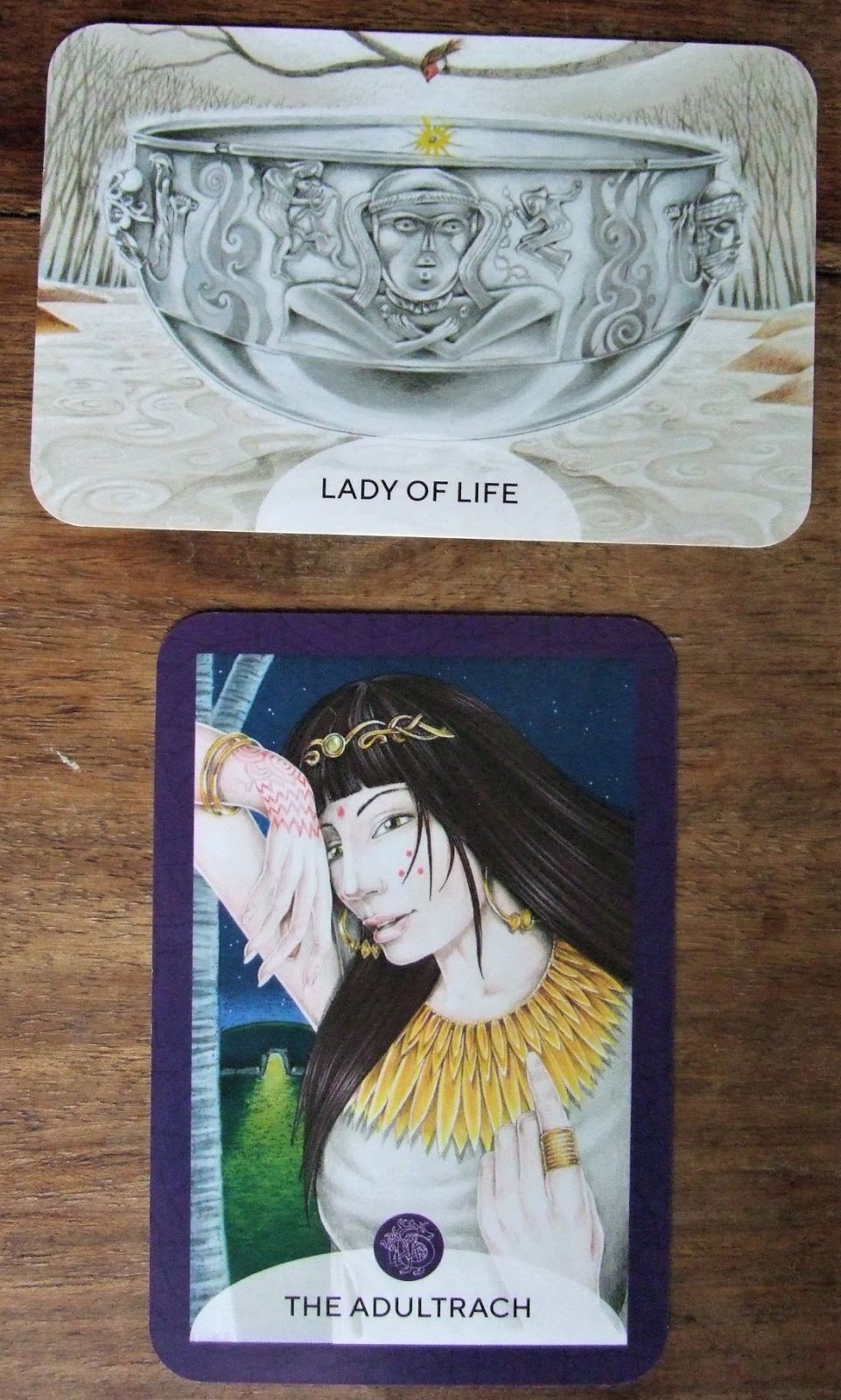
I'm really delighted to have got an early copy of The Ancestral Oracle of the Celts by Caitlín Matthews. It is officially published next week, but my set turned up a couple of days ago. I've been using it every day and I like it a lot, because it has a strong theme with lovely artwork and an original system that works very well.

At first glance, the cards are not entirely different from a tarot deck in that you have something like major arcana and minor arcana. They are split into two groups: the clans, which are a bit like suits, consisting of truth, honour, sovereignty and wisdom; and the divine ancestors, which are more like deities. However, you don't really use The Ancestral Oracle of the Celts like tarot.

Of course you can simply draw a card and look up its meaning, or do a traditional spread, but the two types of card are intended to be used in slightly different ways. The divine ancestor cards offer questions to help you look deeper into issues that affect you, while the clan cards offer insights into the answers. A basic reading involves drawing two cards - one of each type. You look at the divine ancestor first, then the clan card. Other spreads are inspired by Celtic triads; consulting sets of ancestors; and the wheel of the year.

The images for the divine ancestors are inspired by the wonderful Gundestrup cauldron, which is perfect for a deck with a Celtic theme. The images for the clans are inspired by Celtic myths and legends. I really like the artwork, which is stylised but full of symbolism. I'm an intuitive reader - rather than simply wanting to learn what the cards mean using the book - and so having artwork with a good depth of symbolism is important to me.

As an added bonus, as well as being a divination deck, the cards are designed to be usable for family constellation work. The idea behind family constellations is that people's present-day problems can be influenced by issues and traumas suffered in previous generations. These can be worked through using people - or in this case cards - to represent yourself, your family and your ancestors. You then talk to the representative as though they are the relative to try to see all sides of the situation. This can help you feel a greater sense of belonging to your family and help resolve old issues.

I took part in a family constellation for a friend a few years ago and found it to be a very powerful experience. I've not yet tried it for myself with these cards, but I look forward to doing so. You don't need to have actual Celtic ancestors in order to use the cards - they are intended more as archetypes.

The deck comes with an 88-page book and is in a sturdy box. The instructions on how to use the cards and their meanings are clear and concise. Overall, this is an original and versatile oracle set with lovely artwork and theme that is likely to have wide appeal.

You can view the Ancestral Oracle of the Celts on Amazon It is published by Watkins.

Links and previous related posts
https://www.watkinspublishing.com/
http://www.badwitch.co.uk/2015/09/equinox-at-british-museum-celts.html
http://www.badwitch.co.uk/2013/11/review-shamans-oracle-cards-by-john.html
http://www.badwitch.co.uk/2013/01/review-steampunk-tarot-gods-of-machine.html
http://www.badwitch.co.uk/2015/07/review-sacred-sites-oracle-cards.html


Monday, 10 October 2016

London Necropolis: Tower Hamlets Cemetery Park


Before Samhain - or Halloween - for the past few years I've been posting photos of London's burial grounds in a series I've called London Necropolis - a Necropolis being a city of the dead. I've also been visiting London's Magnificent Seven Victorian cemeteries. Up to last Samhain I had visited six of them: Nunhead, Highgate, Brompton, West Norwood, Abney Park and Kensal Green Cemetery.

I visited the seventh - Tower Hamlets Cemetery Park - after Samhain, just too late to include it in my London Necropolis series last year, although I did post a Yuletide picture of holly trees growing among the memorial stones. Here are some more of the photos I took of this truly magnificent Victorian burial ground.

It is called a cemetery park and nowadays is public woods. Situated in East London, it is free to wander around and is a nature reserve as well as being designated a Site of Metropolitan Importance for Nature Conservation. The Friends of Tower Hamlets Cemetery Park, a registered charity, looks after the woodlands and historic graves on behalf of the London Borough of Tower Hamlets.

Sometimes called Bow Cemetery by locals, it opened in 1841 as one of London’s Magnificent Seven Cemeteries that were built in the Victorian era to deal with overcrowding in urban churchyards, which was causing disease and ground water contamination. The other six are those I mentioned - and blogged about - earlier. Tower Hamlets Cemetery closed to burials and become a public park in 1966. In May 2000 it was declared a Local Nature Reserve.

Although it is the least well known of the seven, it is still a beautiful, atmospheric and peaceful place to visit. It is full of wildlife as well as being somewhere to remember our ancestors of place in the East End of London.

On the theme of honouring our local landscape and the ancestors of place, a thought-provoking book that I reviewed in October last year is This Ancient Heart: Landscape, Ancestor, Self. Edited by Caitlín Matthews. It is a series of essays by pagans including Emma Restall Orr, Philip Shallcrass and Professor Ronald Hutton about how the land we live in and those who have lived before us can inspire and affect our spirituality.

It was a book I read not long before visiting Tower Hamlets Cemetery Park and gave me plenty to contemplate as I wandered about the trees and tombs. You can read my review here: http://www.badwitch.co.uk/2015/10/review-this-ancient-heart-landscape.html


Sunday, 6 March 2016

Remembering Mum on Mothers Day


Today, March 16, is Mothering Sunday - or Mothers Day in the UK. It is a difficult time for those whose mothers have passed on.

My own mum died a few years ago, shortly before Mothering Sunday. It felt as though every shop window and every advert I saw reminded me of my grief. But, as time went on and Mothers Days rolled around with the wheel of the year, I began to see the occasion as one on which to remember my mother and the happy memories I have of her, rather than an event to try to shut out entirely.

I usually go into the garden and pick daffodils to put next to a photograph I have of her on my desk. I also light a candle for her and chat to her as if she can still hear me, telling her about things that have happened and that I love her.

Many pagans believe in the importance of honouring our ancestors. Samhain is often seen as the most important festival on which to remember those who have gone before. That is something I do too - scrying for messages from friendly spirits from the Otherworld; ancestors of blood and place and tradition. But Mothers Day is reserved for talking with my mother.

Of course I can never be certain whether she hears me. Even if there is life after death we can't tell if those who have passed through the veil are listening to us. However, it is well documented that those who have lost loved ones can gain comfort from trying to communicate with them, even if all we are talking to is our own memories and our image of them in the place they still hold in our hearts.

Monday, 12 October 2015

Review: This Ancient Heart: Landscape, Ancestor, Self

This Ancient Heart: Landscape, Ancestor, Selfis a new compilation of essays on subjects at the core of many pagans’ spiritual beliefs - the relationship between the landscape, our ancestors and ourselves.

Edited by Caitlín Matthews, author of dozens of books including Singing the Soul Back Homeand Celtic Visions,with druid and activist Paul Davies, This Ancient Heartoffers ten different perspectives on how our place of birth, the country we live in, those who have lived before us and those we share the land with now, can inspire and affect our spirituality.

It starts with beautiful and inspiring writing from Emma Restall Orr and Philip Shallcrass (Bobcat and Greywolf) and ends with an afterword by celebrated historian Professor Ronald Hutton, author of Pagan Britain. The words of other luminaries grace the pages in between.

Emma offers an impassioned call to respect the bones of those who have died – for them to remain buried rather than be dug up by archaeologists and put in museums. She has long campaigned for this as a founder of Honouring the Ancient Dead, and in her essay here she explains her thoughts and feelings on this subject. I know her writing is powerful because it made me question how I had thought about this in the past.

Questioning is good. This is, overall, a book that makes you question preconceived ideas, not a book that reaffirms comfortable complacency. Professor Ronald Hutton, at the end of the book, states that some may feel aggrieved over this, “but they should not, if they really intend this book to have some effect on readers.”

The essays are extremely wide-ranging in their subjects and styles. Greywolf talks about his connection with a tribe of wolf spirits – how that came about where it led him, including his own questioning of whether to eat a venison feast offered to him despite previously having been vegetarian.

Jenny Blain looks at how the “spiritual ways of ‘seidr’ might give some insight to an understanding of the interaction of place and human-person, and how in turn relationships with wights [land spirits] and ancestors form part of how seidr is worked”.

Robert J Wallis offers an evocative description of falconry on a cold winter morning and how it fits into the world-view of a heathen archaeologist.

Caitlin Matthews, as well as co-editing the book,has written a chapter called Healing the Ancestral Communion: Pilgrimage Beyond Time and Space. This offers a practical guide to spiritually connecting with the land in which one lives and also the land of one’s birth. As Caitlin points out, these can be very different. She provided meditative and sensory exercises to heal the rift of disconnection.

Camelia Elias offers a eulogy for a modern ancestor of tradition, Colin Murray. “Throughout the 1970s and 80s Murray was responsible for the revival of all things Celtic in a way that was quite unprecedented.”

Pagans are not the only ones who find meditating on nature can be a spiritual practice. Quaker Sarah Hollingham offers examples and practical exercises in Tuning into the Landscape, that people of all spiritual paths and none could learn from.

Science is addressed in How Genetics Unravels the Role of the Landscape in the Relationship Between Ancestors and Present by Luzie U Wingen.

David Loxley looks at linguistics and how the way we frame sentences affects our view of the past, present and future.

In The Heart of the Land: The Druidic Connection, Penny Billington looks at the importance of keeping balance – symmetry – between literal reality and spiritual yearning. She asks the reader to “imagine yourself for a moment on a hill at sunset, with the quiet buzzing of the insects invisible in the soft light.” She continues:
From your vantage point you look over the dark lake to the west, where the molten streaks of light reflect in a shimmering water-path leading to you, and with the quiet stars appearing in the deep blue overhead. This momentary turning of our attention to the world of nature, even in the imaginal realm, can prompt a surprising sense of relaxation that slows our breathing and our over-busy brains.
She points out: “Science backs up these instincts”.

Perhaps that is the overall message of the book, that it is good for us to feel a connection with the landscape and with those who have gone before us. Whether we follow a religion or spiritual path, or whether we are atheists, it is good to know where we are and where we come from, and spending time in the natural world can be healing.

This Ancient Heart: Landscape, Ancestor, Selfis published by Moon Books and can be ordered via Amazon.

(Note: I earn commission from some links. This helps subsidise my blog at no extra cost to readers)

Monday, 4 August 2014

Event: Lights Out to Commemorate WWI

People all over the UK are being asked to turn the light out tonight between 10pm and 11pm to commemorate the service men and women who gave their lives in the First World War.

August 4 is the centenary of the start of the Great War. On the eve of the conflict, Foreign Secretary Sir Edward Grey spoke the famous words: "The lamps are going out all over Europe, we shall not see them lit again in our lifetime."

This has inspired tonight's event in which people are invited to light a votive candle and spend an hour remembering our ancestors who died in WWI.

For more information, visit http://www.britishlegion.org.uk/remembrance/ww1-centenary/lights-out

The photo shows a memorial to those who died in WWI

Saturday, 26 October 2013

TV: Stories from the Dark Earth: Meet the Ancestors

There's a new documentary series starting on BBC Four tonight called Stories from the Dark Earth: Meet the Ancestors Revisited. The first episode is Pagans of Roman Britain. It is on BBC Four at 8pm today, Saturday October 26. You can find out more here: http://www.bbc.co.uk/programmes/b01s74g9

Thursday, 7 March 2013

Sharing the Stories of our Family and Ancestors

One of my biggest regrets is that I didn't talk to my mother and father enough about their pasts. As a pagan, I like to think I honour my ancestors - yet my family photo album has pictures of my parents when they were younger with people I don't know and places I cannot identify.

A new study by a company that produces journals for recording family history information shows most of us spend little or no time talking to older relatives, including our parents, about their lives. This means that years of family stories could be lost to future generations.

Three quarters of those who responded to the survey admitted they spend little or no time talking to older relatives about their lives and the family stories of their parents.

More than half of us do not talk to our parents or grandparents about our family heritage, while close to 30 percent have never talked to their mother about their own lives. Even more have not chatted to their father about what they did when they were young.

Close to 40 percent of us don’t know how our parents met, 48 percent don’t know when they met and 86 percent don't know how their  or where their dad proposed to their mum, if they are married. More than 60 percent of us don’t know what our parents’ hobbies were when they were children, 40 percent don’t know where our grandmother or grandfather were born and almost a third don’t know our grandmother’s full name.

However, according to the survey it seems that most of us think it’s important to know about the stories from our relatives’ lives to capture this information before it is lost forever. We just don’t seem to be following this through. The results of the survey showed that the older one gets, the stronger these feelings become.

One way to learn more about your relatives before it is too late is to ask them to write down their stories in a journal. The ‘from you to me’ journals, pictured above, are designed to give as gifts to help families do this. The books contain inspiring questions and prompts - as well as space to write the answers - to help capture stories about the people close to you

Rhoda Breakell, head of Genes Reunited, commented on the ‘from you to me’ research results: "The amount of people who don't spend time listening to their parents and grandparents about their family heritage is surprising. We feel it's so important that people listen to the older generations within their families before their stories are lost forever."

As someone who has lost her own mother, I think this is a lovely idea. And with Mothering Sunday (often called Mother's Day) coming up, I think giving your own mum one of these journals as a gift would make an unusual but very appropriate present, especially for a pagan.

Links and previous related posts
www.fromyoutome.com
http://www.badwitch.co.uk/2013/02/pancake-day-is-sad-time-for-me.html
http://www.badwitch.co.uk/2011/02/festival-of-week-parentalia.html
http://www.badwitch.co.uk/2012/10/review-druidry-and-ancestors.html
http://www.badwitch.co.uk/2008/03/mothers-day.html

Wednesday, 24 October 2012

Review: Druidry and the Ancestors

Let's face it, most modern witches or druids would like to be able to boast an ancestor who was a bona fide practitioner of the craft. It doesn't seem to matter how much experience one has as a neopagan, a real witch, druid, wise woman or cunning man in the family history gives that little extra kudos.

Some people I know are lucky enough to have their grandma's genuine handwritten book of spells sitting in the bookcase. And, I suspect, that if most of us were able to trace our ancestry far enough back, or find enough documentation, we would probably find a witchy ancestor or two who fit the bill.

But, of course, the true spiritual importance of ancestors for modern day neopagans - witches and druids alike - is far more than simply being able to boast an impressive magical heritage. It is about honouring those who have gone and have shaped our own lives, "the ancestors of blood, the ancestors of place, and the ancestors of tradition". And most of the druid rituals I have attended have paid special importance to honouring the ancestors by inviting their blessings in the ritual space along with the spirits of place and of nature.

A new book by druid Nimue Brown called Druidry and the Ancestors: Finding Our Place In Our Own History is an exploration of "how we imagine and construct our ancestors, and what the implications are of the ways in which we think about them." Nimue says: "This is a book about making peace with the ancestors, understanding their legacies and their ongoing presence in our lives, and exploring how ancestry impacts on community, and ideas of race, nation and culture."

It is not so much a history book, as a book about the way we relate to various concepts of history - family history, the history of our country and the history of paganism. It looks at the stories we weave about our past, and why they are important to our spirituality. It examines how history books - particularly about ancient history and the druids - can be contradictory and misleading, yet the various insights they give can inspire modern practice. Even the tales we tell ourselves of our fantasy ancestors - the witchy granny we would love to have had even if we have no hard proof she existed - can motivate us in our search for spiritual truth.

Publisher Moon Books says on its website: "Ancestors are part of our shared humanity, we all have them. Ancestry in the guise of race, has been used as a tool to divide. Even so, it might yet help us move in greater harmony. Are we playing out the motifs of our family history, or making our own lives? Are we held back by the past, or empowered by it? And why does any of this matter? Druidry and the Ancestors will take you on a journey into how you imagine yourself, and how you can take control of your identity and future."

Samhain is the time of year when many modern pagans, witches and druids alike, remember relatives and teachers who have died as well as honouring those who lived in the land before us. It is a time when the veil between the worlds is thin and the ghosts of our ancestors of line, place and tradition can return to visit the living, perhaps to give words of wisdom from the past. Druidry and the Ancestors offers insight into how we can make sense of all those stories of our ancestors, and how we can relate to them should we contact their spirits through our rituals, meditations or dreams.

Author Nimue Brown is an OBOD trained druid, a founding member of Bards of The Lost Forest and Druid Network member.

Links and previous related posts
http://www.moon-books.net/books/Druidry-Ancestors
www.moon-books.net
Druidry and the Ancestors: Finding our place in our own history
http://www.badwitch.co.uk/2010/03/witchs-niece-and-magical-key-tree.html
http://www.badwitch.co.uk/2011/02/festival-of-week-parentalia.html
http://www.badwitch.co.uk/2012/09/bbc-radio-programme-about-druids.html
http://www.badwitch.co.uk/2012/06/review-druids-tale.html
http://www.badwitch.co.uk/2008/10/halloween-controversy.html

Wednesday, 7 March 2012

Moon of Death

There's a full moon tomorrow, March 8, at 9.39am London time - although it will appear full tonight and in the evening tomorrow.

While the Medieval name for this is Chaste Moon and the Celtic name is Moon of Winds, according to the online Pagan Calendar, the neo-pagan name for the full moon is March is Death Moon.

Reading this made me feel sad - it was a year ago this week that my mum died after a sudden heart attack. 

This weekend I am going to scatter her ashes and plant a rose in her memory. On the night of the full moon, I shall light a candle and ask the Goddess to keep my mum's spirit safe in the Summerlands.

Links

Friday, 11 November 2011

11th minute, 11th hour, 11th day, 11th year


Today, 11 November, is Armistice Day. Also called Remembrance Day, it commemorates the armistice signed at the end of the First World War between the Allies and Germany for the end of hostilities on the Western Front. It took effect at 11am on 11 November - the "eleventh hour of the eleventh day of the eleventh month" - in 1918.

Although in the UK we honour those who have died defending our country on Remembrance Sunday, which is the Sunday nearest to Armistice Day, 11 November is an important day to remember fallen heroes the world over - for Christians and pagans alike.

For heathens, 11 November is Heroes Day, according to the online pagan calendar. It states that 11 of November is the Feast of the Einherjar, the Day of the Heroes and the day of those choosing to meet in Valhalla: "It honors your ancestors and great heroes. The chosen heroes who sit in Odin's Hall are the Einherjar. Today we honour those dead kin who gave their lives for family and folk. If you have friends or family who died in battle, visit their graves today, if that is not possible, drink a libation in their memory."

In the USA Pagan Warrior Radio also debuts today. This is an internet radio station aimed at pagan veterans and those serving in the US military forces. You can read about it here: http://www.prweb.com/releases/2011/11/prweb8945863.htm

Being a time of remembrance, November 11 is always an important date, but this year the eleventh hour of the eleventh day of the eleventh month also falls on the eleventh year of this millennium - which many consider to a particularly auspicious date and time for personal growth and for changes to take place in the world, quite apart from the date's connection with honouring war veterans.

The Mind Body Spirit Winter Festival in London, which starts today, is hosting a Global Intention Ceremony at that time. The organisers said: "This day is thought by many to represent a special time of personal transformation, expansion of consciousness and unexpected changes in the world." If you are not going to be there, you can watch the ceremony live on the MBS website at http://www.mindbodyspirit.co.uk/

Whatever you are doing today, please spare a moment at least at 11am today to remember fallen heroes and make a wish for a peaceful future.

The photo shows a memorial to soldiers who died in WWI.

Links and previous related posts

Wednesday, 23 February 2011

Ancient history of Stonehenge on TV

Archaeologist Neil Oliver looks at the ritual significance of Stonehenge in the TV documentary series A History of Ancient Britain on BBC2 tonight as he explores the age of cosmology. He offers the theory that the stone circle was a monument to the dead and that our ancestors worshipped there at midwinter, rather than at the summer solstice.

This is the third episode in A History of Ancient Britain. Last week Neil Oliver looked at how and why ancient Britons buried their dead at West Kennet Long Barrow and also at the massive megalithic rows of stones at Carnac, in France.

Programmes on BBC TV Channels are usually available to watch on iPlayer for at least a week after they are shown: http://www.bbc.co.uk/iplayer/

You can also order A History of Ancient Britain Series 1 DVDthrough Amazon.

Links
http://www.badwitch.co.uk/2010/07/news-archaeologists-find-henge-next-to.html
http://www.badwitch.co.uk/2009/05/secrets-of-stonehenge.html
http://www.badwitch.co.uk/2008/09/secrets-of-stonehenge-uncovered.html
http://www.badwitch.co.uk/2008/04/archaeologists-investigate-stonehenge.html

Friday, 11 February 2011

Festival of the Week: Parentalia

This Sunday, 13 February, is Parentalia - the Roman festival at which people in classical times honoured their dead parents.

Families would gather among the tombs of their ancestors and make offerings of grain and wine to their dead loved ones. On this day, temples were closed, marriages were forbidden and public officials took a day off work.

However, this weekend is also the anniversary of the death of Gerald Brosseau Gardner, on 12 February, 1964. Gerald Gardner is often called The Father of Modern Wicca, and this festival would be an appropriate time for all Wiccans to honour him as their spiritual father - as well as visiting the graves of their own ancestors who have passed through the veil of death, or remembering them in other ways.

Links:
Gerald Gardner and the Cauldron of Inspiration: An Investigation into the Sources of Gardnerian Witchcraft
http://en.wikipedia.org/wiki/Parentalia
http://en.wikipedia.org/wiki/Gerald_Gardner
http://pagancalendar.co.uk/
http://www.badwitch.co.uk/2010/12/pagan-eye-where-witches-walked.html
http://www.badwitch.co.uk/2010/09/day-for-gerald.html
http://www.badwitch.co.uk/2010/09/charge-of-goddess-conference-2010.html
http://www.badwitch.co.uk/2009/01/wicca-witchcraft-finding-out-basics.html

Saturday, 13 December 2008

What to do at Yule if you're pagan

I often get asked by pagans who are new to their path, or who are not in a coven, what they should do to celebrate at Yule - a pagan name for festivities in late December, at around the time of Christmas.

Pretty much everyone, of every faith and culture, seems to have something to celebrate around midwinter - December 21. It is one of the oldest known festivals and our ancient ancestors constructed huge monuments, such as Stonehenge, to mark the dawning of the sun after the longest night of the year.

We don't know exactly what people did as far back as the time Stonehenge was built, but many modern pagans still like to watch the sun's renewal on the midwinter solstice. If you have a stone circle or megalith nearby, you will almost certainly find you are not alone if you go there on December 21. Other popular places to watch the dawn are hilltops and east-facing cliffs and beaches.

But, lets face it, the weather is pretty grim at this time of year and you have to be quite hardy and determined to climb up some icy hill in the dark, with a bitter wind blowing and maybe even a blizzard, just to watch the sunrise.

Many of our pagan ancestors would much rather spend midwinter huddled around the fire, enjoying a drink and playing games to keep themselves cheerful until the days were obviously getting a little lighter. Doesn't sound that dissimilar to what most of us do today, does it?

Marion Green, in her book A Witch Alone: Thirteen Moons to Master Natural Magic, describes how communities would burn a huge Yule log and keep it burning throughout midwinter night. They would deck their homes with evergreens, red holly berries and white mistletoe. These are considered sacred by druids, but also kept the halls smelling sweet and looking festive.

Bringing greenery into the home is something we do today, even though the Christmas tree itself is quite a modern tradition in England. As a pagan, you might want to say a few words to the spirits of the plants as you bring them into your home and ask for their blessing. Both holly and mistletoe are protective plants and guard the home against mischief or accidents, while pine promotes fertility and long life, according to Cunningham's Encyclopaedia of Magical Herbs .

Kate West in The Real Witches' Handbook suggests several other ways pagans can celebrate Yule that fit in well with a modern Christmas. Light a yellow or orange candle, the colour of the sun, before sunrise on the solstice. While it burns, think about the reasons you are celebrating this season and also consider what you want to be renewed in the year ahead. You can either watch until it burns down, or light it for a short time each day over the festive period. Remember not to leave any candle unattended. Yule might be a fire festival, but you don't want to burn your own house down.

Food is a vital part of yuletide celebrations. Kate West also suggests making your own chocolate yule log. Put a cake candle on it for everyone present. As people light their candle, they should make a wish. Then they can enjoy eating the cake and share the blessings of the season.

If you want to do a more elaborate ritual but aren't in a coven or pagan group, then the website pagan-magic.co.uk has a lovely Solitary Yule ritual that you can download for free. Other books that contain good Yule spells and rituals to perform alone include Wicca: A Guide for the Solitary Practitioner (Llewellyn's Practical Magick) and Llewellyn's 2009 Witches' Spell-a-day Almanac.

Links:
http://www.badwitch.co.uk/2008/09/secrets-of-stonehenge-uncovered.html
A Witch Alone: Thirteen Moons to Master Natural Magic
The Real Witches' Handbook
Encyclopaedia of Magical Herbs (Llewellyn's Sourcebook Series)
http://pagan-magic.co.uk/shop/index.php?ad=badwitch
http://pagan-magic.co.uk/shop/solitary-yule-ritual-a-1062.html?ad=badwitch
Llewellyn's 2009 Witches' Spell-a-day Almanac
Wicca: A Guide for the Solitary Practitioner (Llewellyn's Practical Magick)

Sunday, 20 April 2008

The world's most ancient tree

The world's oldest tree has been discovered, in Sweden.

The tree is a spruce that first grew at end of the last ice age, more than 9,500 years ago. It was discovered in the Fulu Mountains, Dalarna, in central Sweden and is among a cluster of trees that have been carbon dated to over 8,000 years old.

Swedish scientists from Umea University believe that the trees have managed to survive for so long because every winter the snow pushes low-lying branches into the ground where they take root. Although the original mother trunk may die, the branches form new trunks that are genetically the same tree.

Ancient trees appear in many culture's mythologies and are often colossal, with their branches supporting the heavens, their trunk in the realm of the Earth and their roots in the underworld.

Yggdrasil is the World Tree in Norse mythology. It is a giant ash that links all the worlds. In the folklore of Siberia, the World Tree is also the symbol of Mother Earth who gave the Samoyed shaman a magical drum and helped him travel from one world to another.

World trees also feature in ancient South American mythology, where they embody the four cardinal directions as well as linking the sky and the ground.

No one is suggesting that the elderly spruces found in Sweden represent anything quite so mythic, but there is evidence that these trees were highly valued by our ancient ancestors. Scientists believe the original saplings may have been transported some distance and deliberately planted. Trees would have been in very short supply supply and their wood would have been vital for survival.

It is easy to understand why fabulous stories were told about them around fires of crackling pine cones on cold nights.

For more information:
www.telegraph.co.uk/earth/main.jhtml?view=DETAILS&grid=A1YourView&xml=/earth/2008/04/17/eatree117.xml
www.kheper.net/integral/tree.html
http://en.wikipedia.org/wiki/World_tree