Showing posts with label legends. Show all posts

Tuesday, 17 October 2017

Occult London: The Devils of Cornhill


If you are walking along Cornhill, in the City of London, do look up when you get to the office building at numbers 54 and 55. Perched on the roof you will see a fine group of devils.

Most tourist guides say there are three Cornhill Devils - two large ones and a small one - but actually there are others hidden among the cornices and decorative features of the building. They are best described as gargoyles and the three main ones are made of terracotta, but no one knows exactly why they are there.

One London legend has it that back in Victorian times, there was a disagreement between the architect Ernest Augustus Runtz, who was designing the office building, and the vicar of St Peter-upon-Cornhill, which is next door. The vicar said that the planned offices were slightly encroaching on Church land and forced the design to be changed to prevent it. In retaliation, the architect placed devils on the roof after the building was constructed, staring at the church, to get his own back.

It is a good story, but might just be that.

Links and previous related posts
http://hidden-london.com/the-guide/cornhill-devils/
https://www.london-walking-tours.co.uk/secret-london/cornhill-devils.htm
http://www.badwitch.co.uk/2017/07/occult-london-london-stone-myths-and.html
http://www.badwitch.co.uk/2014/09/occult-london-barbers-physic-garden.html

Sunday, 5 April 2015

News: Easter, Curse, Legends, Hidden City, Occult


"Easter Traditions – Wacky, Wild And Weird" - story at cheapflights: http://www.cheapflights.co.uk/news/easter-traditions-wacky-wild-and-weird/

"'Black magic' curse inscribed onto ancient stone tablet calling on the 'mother of witches' to bind victim found hidden in museum" - story at mailonline: http://www.dailymail.co.uk/sciencetech/article-2148601/Black-magic-ancient-curse-revealed-Roman-tablet-hidden-museum.html

"UK days out with myths and legends" - story at the Guardian: http://www.theguardian.com/travel/2015/mar/31/walks-myths-legends-day-trips?

"Man digs under house and finds 5,000-year-old underground city" - story at the Metro: http://metro.co.uk/2015/04/03/man-digs-under-house-and-finds-5000-year-old-underground-city-5133521/

"Tahuti Antiquarian Occult Bookstore Website Launch" - story at pr.com: http://www.pr.com/press-release/612556

"Witches and bonfires: Ostrobothnia celebrates Easter" - story at yle: http://yle.fi/uutiset/witches_and_bonfires_ostrobothnia_celebrates_easter/7910011

Tuesday, 9 July 2013

Review: Curiocity D - London Dissected


Curiocity, for those who haven't already heard about it, is little publication about unusual things you can find in London. Each issue has a map of the city with a different theme based on a letter of the alphabet - but unlike the familiar A-Z guides to London's streets, Curiocity features the weird and wonderful rather than the mundane.

The new issue of Curiocity  - letter D - is now on sale, and the theme is London Dissected. This issue features a central map by award-winning illustrator Nicole Mollett, showing London as a human body laid open with the Thames as its gastrointestinal tract.

It might sound a little ghoulish, but it is really quite fascinating. In it you can find out where historical surgeons cut open human bodies in anatomy schools and delve into the bowels of London with a walk down Fleet Street, a trip to "Farting" Lane or a visit to the Crossness Pumping Station that for many years helped shift the capital's sewage.

Rather like a Time Lord, London has two hearts according to Curiocity. One is St Paul's Cathedral on Ludgate Hill, which legend links to an ancient lunar temple of Diana, the second is Westminster Abbey, associated with the sun and Apollo.

Getting physical, you can find out if you are strong enough to lift a gold bar at the Bank of England, the best place for sunbathing, or a good greasy spoon cafe for a slap-up full English breakfast.

You can order a copy of Curiocity D and previous issues here: http://www.curiocity.org.uk/buy-online/

Links and previous related posts
http://www.curiocity.org.uk/buy-online/
http://www.badwitch.co.uk/2012/05/london-walks-curiocity-and.html
http://www.badwitch.co.uk/2013/03/curious-city-unusual-evening-in-london.html
http://www.badwitch.co.uk/2009/09/mystical-legendary-london-in-day.html
http://www.badwitch.co.uk/2010/09/review-londons-ley-lines-pathways-of.html
http://www.badwitch.co.uk/2013/07/images-and-reflections-of-thin-veil-of.html

Saturday, 6 April 2013

London's Ghosts, Legends and Mysteries Mapped


The map above shows various ghosts, legends and mysteries of London on Google Maps. The information on it was created by James Clark, author of the book Haunted London.

It looks as though it would be a fascinating and useful resource for anyone interested in exploring the haunted places in London. Thanks very much to Paula Dempsey who told me about it.


Thursday, 6 September 2012

Dozmary Pool and the Death of Dragons


This sad and gloomy landscape is Dozmary Pool, on Bodmin Moor. Legend says it is where King Arthur was granted Excalibur and also where Sir Bedivere returned the magical sword as Arthur lay dying after the Battle of Camlann.

I very much wanted to visit the lake when I was in Cornwall last month, but foolishly left finding the site until the very end of my holiday. That turned out to be a day of rain and mists - not a good time to venture out on treacherous and boggy Bodmin Moor; hardly a day to venture outside at all.

It would have been much more sensible to find a cosy pub, enjoy a glass or two of Cornish cider and shelter from the storm. But I was determined to visit the home of the Lady of the Lake, so I donned my walking boots and waterproofs, grabbed my OS Map of Bodmin, and set out on my quest.

Luckily, Dozmary Pool is quite easy to find as it isn't too far from a well-marked, if narrow, lane. However, after weeks of bad weather, the footpath that leads to the edge of the pool was seriously waterlogged. Wellies would have been better than walking boots, I soon discovered, as the mud was up to my ankles in places. Perhaps unsurprisingly, the lake was deserted when I got there.

I'm not really sure what I expected to find. I guess everyone with a love of Arthurian Tales who visits Dozmary Pool faintly hopes they might spot some rusty old sword lying at the water's edge.

What I saw, apart from the dark waters of the lake, was a huge dragonfly in the long grass on its bank. When the creature didn't fly away as I crept closer to photograph it, I realised it was dead. Rest in peace, Child of the Dragon, I thought, wondering if there was some subtle, magical message here for me after all.

Turning round, I spotted a small, perfectly white mushroom also growing by the water's edge.

I'm no expert in wild fungi, but it seemed as though a voice whispered in my ear: "What you see is a Destroying Angel. It is deadly. This is a place of death; do not take anything, do not touch anything, do not stay longer than is necessary to pay homage to the dead and to that which has gone."

So I did. I stood in silent contemplation, listening to the sound of the wind and the lapping of water. I thought of the death of King Arthur, and how this place could not have changed much over the centuries. A distant house and a rusty barbed wire were all I could see of the modern world.

As I turned to leave, silently thanking the Lady of the Lake for letting me find this sacred place, it seemed the voice whispered again in my thoughts: "You do not need a sword, your words are your weapons of power. Use them well."

"I will," I thought. "I promise."


Links and previous related posts
http://en.wikipedia.org/wiki/Dozmary_Pool
http://en.wikipedia.org/wiki/Destroying_angel
http://www.badwitch.co.uk/2012/08/boscastle-and-museum-of-witchcraft_3235.html
http://www.badwitch.co.uk/2012/08/tintagel-castle-and-legacy-of-king.html
http://www.badwitch.co.uk/2012/08/pagan-eye-hurlers-stone-circles.html
http://www.badwitch.co.uk/2010/08/tv-king-arthur-and-green-knight.html
http://www.badwitch.co.uk/2009/08/ghosts-and-grails-of-lewes.html
http://www.badwitch.co.uk/2011/10/chalice-well-goddess-and-grail.html

Tuesday, 28 August 2012

Tintagel Castle and the Legacy of King Arthur


I'm back from a fantastic holiday in Cornwall, but still have plenty to blog about. I'll start with Tintagel Castle.

In legend, Tintagel Castle, perched high on the windswept, rocky cliffs of North Cornwall, is the place where King Arthur was born - or at least conceived. This is the story told by Geoffrey of Monmouth in his 12th century book The History of the Kings of Britain.

Although the ruins of the castle that stand in Tintagel today date from the Middle Ages, archaeologists have found artifacts from Romano-British times at the site. Of course, whether King Arthur ever existed or not is a matter of debate and speculation, but tales of England's Once and Future King have only gone from strength to strength. Tourists have long flocked to Tintagel hoping to connect with Arthurian legend, to walk in the footsteps of Arthur Pendragon, Guinevere and Lancelot, and maybe discover a hint of magic in nearby Merlin's Cave.

Whatever your thoughts about King Arthur, Tintagel Castle is a spectacular place to visit. To get there you will have a long walk on a steep and narrow path, then a climb up a very long flight of steps that cling to the side of the cliff, but the views are worth it. You can explore the romantic ruins, look out over the sea and watch seagulls wheeling overhead while waves crash on the rocks below. Bring a picnic, as it is a beautiful spot for one on a sunny day. If it is stormy, then bring your most serious waterproofs.

However, the town of Tintagel is, by contrast, rather tacky – full of Arthurian-themed tourist tat. Of course, that's only my opinion – maybe you fancy being The Girl Who Pulled the Plastic Sword from the Bucket, slaying slot machine dragons in Camelot amusement arcade and then gobbling down Lancelot's giant sausage in a bun from Ye Olde Excalibur Kebab Shoppe (OK, I made that last one up, but the first two are for real). I suppose you can't really blame the local traders for trying to cash in on the Arthurian hype, but frankly it put me off wanting to spend any money in the town at all.

If you happen to be in Cornwall this week, then I'd recommend visiting Tintagel Castle tomorrow, 29 August, as you'll be treated to costumed storytellers relating King Arthur's Tales. I went last week and enjoyed the performance more than I expected - it really isn't just for kids. You can find out more about it here: http://www.english-heritage.org.uk/daysout/events/king-arthurs-tales-tc-29-aug/


The pictures top and bottom show views of Tintagel Castle, the top side photo shows the King Arthur's Tales being performed, the bottom side picture shows the kind of stuff on sale in the town of Tintagel.

Links
http://www.english-heritage.org.uk/daysout/properties/tintagel-castle/
http://en.wikipedia.org/wiki/Tintagel_Castle
The History of the Kings of Britain (Classics)
http://www.english-heritage.org.uk/daysout/events/king-arthurs-tales-tc-29-aug/


Friday, 6 July 2012

Pagan Eye: Wayland's Smithy on a Sunny Day


These pictures of Wayland's Smithy were taken one sunny Good Friday by Sophie Mason, who has kindly let me post them on my blog.

Wayland's Smithy is a Neolithic long barrow and chamber tomb site near the Uffington White Horse, at Ashbury in Oxfordshire.

Wayland's Smithy is associated with the Germanic smith-god Wayland or Wolund, although the name was given to the site by the Saxons who settled in the area four thousand years after the long barrow was built. According to legend, a traveller whose horse has lost a shoe can leave the animal and a silver coin on the capstone at Wayland's Smithy. The next morning they will find the horse has been re-shod and the money has gone.

Sophie, thanks very much for letting me use your lovely photos. This is another site that I really want to visit for myself.

My Pagan Eye posts show photos that I find interesting - seasonal images, pagan sites, events, or just pretty pictures. If you want to send me a photo for a Pagan Eye post, please email it to badwitch1234@gmail.com Let me know what the photo shows and whether you want your name mentioned or not. For copyright reasons, the photo must be one you have taken yourself.


The photos are copyright Sophie Mason


Links and previous related posts
http://en.wikipedia.org/wiki/Bryn_Celli_Ddu
http://www.badwitch.co.uk/2012/06/pagan-eye-rollright-stones.html
http://www.badwitch.co.uk/2012/06/pagan-eye-lake-nemi-and-sacred-groves.html
http://www.badwitch.co.uk/2012/06/pagan-eye-path-through-ancient.html

Thursday, 28 April 2011

Festival of the Week: The Royal Wedding

Beltane or the Royal Wedding? It was a tough choice between them for The Bad Witch's Festival of the Week.

After all, Beltane - or May Day - is one of the most popular pagan festivals of the year, with all sorts of fun and games taking place to celebrate the start of summer. And the Royal Wedding, being a Church of England ceremony, is hardly pagan.

However, it is a huge event that pretty much everyone in England is going to celebrate in some way, whether they are going to London tomorrow for a glimpse of Will and Kate on their big day, bedecking their homes with flags and throwing a party or just settling down in front of the telly with a cuppa at around 11am. Looking at it that way, The Royal Wedding of Prince William and Kate Middleton has to be The Bad Witch's Festival of the Week.

Many pagans are royalists. They like all the history and tradition associated with having a Royal Family that you don't get with a president. And although The Royal Wedding might not be a pagan event, it is taking place very close to Beltane, which is the pagan festival of fertility. Many pagans honour the sacred marriage of the God and Goddess on the first of May, their union promising that the land will flourish and bring a bountiful harvest.

Some pagans and Christians alike look to the Grail legend and the concept that the health of the land is mystically connected to that of its King. And Prince William is in direct line of succession to the throne, after his father Charles, Prince of Wales.

Even if you don't buy in to those folk tales, the Royal Wedding is at least something to cheer us all up during these dark days of economic uncertainty.

But, however wonderful the ceremony looks, I won't be calling Prince William and Kate Middleton's big day a fairytale wedding. I'm sure there will be all the pomp and spectacle that one would expect for such a momentous occasion and the couple will look gorgeous in their finery.

For me, there was only one fairytale Royal Wedding - that of Prince Charles and Lady Diana. I watched it when I was young - young enough to believe that real life can be a fairy tale. But it isn't, and the story of Charles and Diana's marriage certainly had no fairytale ending.

Nevertheless, if a Bad Witch can make a wedding day wish for Will and Kate it is this - that they can, and will, live happily ever after.

The picture shows the BBC DVD of The Royal Wedding - William and Catherine, which is available to order through Amazon.

Links and previous related posts:
http://www.officialroyalwedding2011.org/
The Royal Wedding - William & Catherine (BBC) [DVD]
http://www.badwitch.co.uk/2011/04/review-discovering-folkore-and.html
http://en.wikipedia.org/wiki/Prince_William_of_Wales
http://www.badwitch.co.uk/2010/05/working-with-emerald-tablet.html
http://www.badwitch.co.uk/2008/04/beltane-frolics-and-wicker-man.html
http://www.badwitch.co.uk/2009/08/ghosts-and-grails-of-lewes.html
http://en.wikipedia.org/wiki/Fisher_King

Tuesday, 31 August 2010

Review: Align - Ley Lines in the Limelight

Last Wednesday I went to see Align, a live show on London history, myth and psychogeography, at the Museum of London.

The museum gave it the subtitle of Ley Lines in the Limelight. It was essentially a theatrical talk and artistic slideshow presentation about London's ley lines and psychogeography.

As most readers of A Bad Witch's Blog will know, ley lines are straight lines that run through prominent points in the landscape. One theory about why ley lines exist is that they follow prehistoric tracks, often leading through sites of spiritual or cultural significance such as wells, megaliths, mounds and temples. Some people also believe that earth energy is channeled along ley lines, empowering - or powered by - the holy sites along the way.

Psychogeography is the theory that the landscape and geography of a place affect the psychology of those who live or work there so that similar types of activity tend to reoccur in the same place throughout history.

In Align, psychogeographers Robert Kingham and Richard Cochrane (pictured right) explore the secret landscape, history and myths of London. They concentrate on places and events that have happened along the Strand Ley, which runs through St Martin-in-the-Fields, St Mary-le-Strand, St Clement Danes, St Dunstan's in Fleet St and Arnold Circus (pictured above), which was once the site of a friary and later became a notorious area of poverty.

Of course, much of the history of these sites is well documented in regular guide books - and even their secret history has been written about in books such as Christopher Street's Earthstars, John Matthews and Chesca Potter's Guide to Legendary Londonand Merlin Coverley's Occult London.

But if you think you are an expert on London's past, Align might still open your eyes to a few things you didn't know, as Robert Kingham and Richard Cochrane have done a wonderful job of unearthing strange and fascinating facts about England's capital.

I personally learnt two things about the area where I worked in for three years, near Old Street, in East London.

The first thing was that The Tower Theatre Company, while excavating the foundations for a new theatre, found they were building directly on the site of London's first ever purpose-built theatre.

The second thing I learnt was that the office I worked in, in Scrutton Street, was next to a vinegar yard owned by the family that later had the dubious claim to fame of discovering and mining blue asbestos. Blue asbestos was found to cause asbestosis and is a substance that has killed many people who came into contact with it. Scrutton Street is also the possible former location of an ancient mound said to have been the site of plague burials.

Those types of synchronicity are points of similarity on the time-line of places that can be compared to points of interest on geographical lines that are called leys. That seems to me to be the comparison that Align tries to make between ley lines and psychogeography.

Of course, I can't help realising that, by that theory, my working in that area of East London makes me a prime candidate to become either an aspiring thespian or a mass killer. I don't think I've killed anyone yet...

You can find out more about Align and watch a six-minute trailer for it at http://bigi.org.uk/align/. Robert Kingham and Richard Cochrane are planning future dates for Align, possibly at the Museum of London or at universities, so check their website for updates.

Link:
http://bigi.org.uk/align/
http://www.museumoflondon.org.uk/English/
http://www.badwitch.co.uk/2009/01/ley-lines-and-london-walkiing.html
http://www.badwitch.co.uk/2009/09/mystical-legendary-london-in-day.html
http://www.badwitch.co.uk/2009/02/psychogeography-by-merlin-coverley.html
http://www.badwitch.co.uk/2007/12/spirit-of-city.html
http://www.leyhunter.com/archives/tlh2.htm
http://www.earthstars.co.uk/visionary-landscape-walks/
Earthstars: Geometric Groundplan Underlying London's Ancient Sacred Sites and Its Significance for the New Age
Guide to Legendary London
Occult London

Tuesday, 13 October 2009

The Brompton Cemetery Time Machine

The moment I heard about the Brompton Cemetery Time Machine - at the London Lore conference earlier this year - I knew I had to see it for myself. After all, who could resist a tale of Egyptian tombs, royal mistresses, a weird scientist who may have been murdered to prevent his invention falling into the wrong hands - and a locked door with a missing key to a strange building for which no floor plans have been found, but which may hold the secrets of time itself.

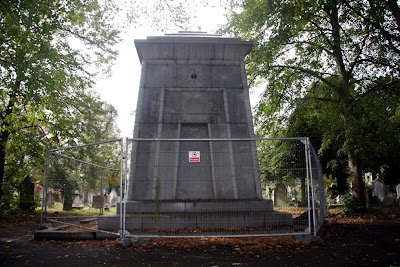
The story centres on an Egyptian-style mausoleum in Brompton Cemetery - and I finally got to visit it on a crisp autumn day in October, in the approach to Halloween.

Brompton Cemetery, in the London Borough of Kensington and Chelsea, was established in 1836 and opened in 1840 as one of Victorian London's much-needed new burial grounds at the time. It is run by the Royal Parks and is unusual in that it is the only Crown Cemetery.

Another unusual thing about Brompton is that, as graveyards go, it has very few ghosts. London's other cemeteries - such as Highgate, Nunhead and Kensal Green - are most decidedly haunted, but the dead at Brompton seem to genuinely rest in peace.

That is, unless tales of time travel are to be believed - first revealed to the public in newspaper headlines in the last decade of the 20th century.

A Reuters story dated October 10, 1998 stated:

"Shrouded by trees in the middle of London's Brompton cemetery stands a strange, imposing structure carved with elaborate Egyptian-like figures that has been exciting the interest of writers and researchers. The 150-year-old mausoleum is the only one in the cemetery for which no plans can be found.

"Its occupants are a mysterious trio of spinsters about whom almost nothing is known. Intrigued by the tomb, writer Howard Webster began researching its origins and now believes the 20-foot tall building was a time machine built by a maverick Victorian genius, Samuel Warner, who also invented the torpedo. Warner is buried in an unmarked grave about 70 feet from his creation and in another nearby grave lies his likely collaborator, architect and Egyptologist Joseph Bonomi."

What adds to the mystery is that some people believe Warner, who was in negotiations over his plans for aerial bombs and sea mines with Duke of Wellington, commander in chief of Britain's army, was either murdered to prevent his designs for weapons falling into the wrong hands, or by someone who stole them from his dead body. However, others believe Warner was either a crackpot or a fraud whose inventions could never have worked.

Warner's colleague Bonomi was in the team of Egyptologists and archaeologists who first deciphered the hieroglyphic texts found on papyri in Egypt's Valley of the Kings.

James Mackay, a spokesman at Brompton cemetery, reportedly said at the time of the Reuters story: "It could be that some of the papyri they were decoding dealt with time travel."

The Victorians were fascinated with theories about time travel - exemplified by HG Wells' book The Time Machine. They also came up with the idea that the ancient Egyptians might have had devices that could transport people through time and space - a concept used in the film and TV series Stargate.

Webster speculated that if Warner and Bonomi had come up with plans for a time machine, they would have needed considerable funds to build it. Their backer could have been the three women who supposedly occupy the tomb - Hannah Courtoy and her two daughters Mary Anne and Elizabeth.

Courtoy was not Hannah's real name, but one she used for convenience because she was the mistress of wealthy merchant John Courtoy. She outlived him and some speculate that she later became the mistress of royalty. She knew Bonomi and may have funded his expeditions.

The Reuters story went on to explain why Hannah's tomb was thought to be a time machine:

"The trapezoid of dark polished granite is decorated with narrow bands of carved hieroglyphics and has a huge bronze door for which there is no surviving key. It has not been opened for more than 120 years. Sixty feet away, Bonomi's gravestone bears similar hieroglyphic carvings including the Egyptian god of the dead, Anubis, sitting on what appears to be a replica of the mausoleum. Webster believes this is a vital clue to the mausoleum's secret. The direction Anubis is facing - toward the mausoleum - suggests in Egyptian mythology a soul lost out of time."

In 1998, Mackay said he thought that Warner was a hoaxer who might have conned the Courtoys into believing he could build a time machine. However, he added: "The biggest mystery is that you couldn't build anything in the cemetery without plans and there are no plans. His choice of the cemetery was a shrewd and appropriate one ... it was one of the few places where one could work unobserved and where even the most eccentric of structures could be explained away. A cemetery where the wealthy and famous are buried is also a location that one could say with great certainty is unlikely to be the subject of redevelopment over time ... like Egyptian tombs, where structures could remain intact over centuries.''

Hannah Courtoy died in 1848, but her mausoleum was not finished until 1853 - the same year Warner died and when Bonomi's headstone stone was erected. Webster said: "I like to believe that Warner's is not the body in the unmarked grave but that he is still alive and travelling through time in his machine.''

The story of the Brompton Cemetery Time Machine grew in fame in 2003, when the Courtoy mausoleum was used as the cover picture for the ambient electronic album Musick That Destroys Itself by Mount Vernon Astral Temple.

It contains two tracks: Warner's Reverie and London Praises Its Ancient God, which reviews describe as "spacey".

Yet the album's title could almost be considered a premonition, because not long after it was released, the mausoleum began to self-destruct. Chunks of granite began to fall from its surface and cracks appeared in the lintels above the doors.

Someone I spoke to in the cemetery, who did not give their name, said: "It could be entropy catching up with it or might have been struck by lightning while journeying through time. Who knows what could happen if it malfunctioned?"

"I wouldn't stand too close," they added.

Arthur Tait of the Friends of Brompton Cemetery gave a far more rational explanation for the damage. "It was caused by frost two or three winters ago," he told me.

He said: "It will cost several thousand pounds to have it restored. Unfortunately, the Royal Parks do not have the necessary money available. We have told them that the Friends would be willing to contribute a bit towards the cost, however no action yet. I hope we can get progress on this next year."

At the moment, the mausoleum is in a sorry state, with lumps of fallen rock lying at its base, its steps overgrown with weeds and its main metal doorway tarnished and discoloured. It is surrounded by a wire fence with signs warning people to "Keep out".

Time machine or not, it would be a shame if the mausoleum is left to crumble. Perhaps some mysterious benefactor, strangely attired in outlandish clothing, will turn up one day soon to donate the necessary money to restore it to its former glory? I do hope so...

Links

http://www.brompton-cemetery.org/
Musick That Destroys Itself
http://www.compulsiononline.com/Mount%20Vernon%20Astral%20Temple%20-%20Music.htm
http://www.badwitch.co.uk/2009/04/review-london-lore-conference.html
http://www.badwitch.co.uk/2009/07/strange-dreams.html
http://www.badwitch.co.uk/2008/02/green-and-pleasant-land.html
http://www.forturi.com/app/page/TVSpooks
http://www.royalparks.org.uk/parks/brompton_cemetery/
http://209.85.229.132/search?q=cache:v1eglBjcP-kJ:archiver.rootsweb.ancestry.com/th/read/LONDON/2001-09/1001487299+brompton+cemetery+time+machine&cd=1&hl=en&ct=clnk
The Time Machine (Penguin Classics)
Stargate S.G. 1 - Series 1-10 - Complete/The Ark Of Truth/Continuum [DVD] [1997]

Thursday, 8 October 2009

The London Stone: The ancient heart of London

The London Stone - a worn limestone block - is one of the city's most ancient relics and also one of its greatest mysteries.

It currently stands in a metal cage embedded in the wall of an old bank at 111 Cannon Street, almost opposite the tube station, but its origins are lost in the mists of time. That, at least, is what you will read if you do the Ghosts of the Old City walk in the London History and Mystery book of walks. The book goes on to say:
"It has been suggested that it was once part of a ritualistic or sacrificial druidic altar or stone circle. The most popular theory, however, is that it was a Roman milestone."
Actually, calling The London Stone a milestone is probably a great understatement. William Camden in his great work Britannia - written at the time of Elizabeth I - claimed The London Stone was a Milliarum or the central markstone from which Roman roads radiated from the centre of the city. Even if The London Stone was Roman in origin, it was the city's stone heart, to and from which all roads led.

According to The Aquarian Guide to Legendary London, tradition says The London Stone "was originally a temple altar-stone laid by none other than Brutus the Trojan, the mythical founder of Britain". The book states:

"Because of this, it was considered to be a sacred object upon which oaths were sworn. The stone was also the point from which authoritative proclamations were made. Also, the tradition of striking one's sword against the stone as a symbol of sovereignty was observed in 1450 by the Kentish insurgent, Jack Cade. On striking his sword on the stone he declared himself Lord of the City."
Jack, the rebel and people's hero, came to a sticky end shortly afterwards, so this example is perhaps not the greatest proof of The London Stone's mystical powers. However, the stone has fascinated people for centuries. Queen Elizabeth I, her occultist John Dee, playwright Shakespeare, architect Sir Christopher Wren and poet and visionary William Blake all believed that the stone was of great symbolic and perhaps mystical importance.

City of London guide Robert Stephenson pointed out in his lecture on Mystical and Legendary London that The London Stone stands on important London ley lines, including Alfred Watkin's Strand ley. This runs from St Martin's Ludgate through St Paul's Cathedral, along Cannon Street, through The London Stone to All Hallows and ends at Tower Hill, where The Tower of London stands.

Hedley Swain, archaeologist at the Museum of London, has confirmed that The London Stone is ancient, but said there is no way of confirming its date or original purpose.

People today still venerate The London Stone. When I photographed it, I noticed flower petals had been put through the grating in front of it, an offering to the ancient and enigmatic geomantic marker.

A couple of doors away, The London Stone has also given its name to a fun gothic-themed pub, run by the Eerie pub chain. With an interior designed like the set of a horror film, this pub is definitely worth visiting after an autumnal walk around London's sacred sites in the run-up to Halloween.

Tuesday, 6 October 2009

The lost sphinxes of London

These sphinxes sit at the foot of a stairway to nowhere in a neglected and overgrown corner of Crystal Palace Park, in south east London.

Copied from ancient Egyptian sphinxes in the Louvre, Paris, they once they guarded the entrance to the mighty Crystal Palace - the iron-and-glass temple to Victorian splendour that originally housed the Great Exhibition of 1851 in Hyde Park, and was then moved to top of the highest hill in south London, on the border between the greater city and the county of Kent.

Crystal Palace burnt to the ground in 1936, leaving its feline guardians bereft of purpose and looking as though they had taken a left turn at Luxor and didn't know how to get back.

A sphinx is a mythological creature with the body of a lion and the head of a woman. They were usually placed as guardians at the entrances to royal tombs or religious or magical sites.

Their name is thought to either come from the Greek word sphingo, meaning to strangle, or the Egyptian word shesepankh, meaning living image. One can easily imagine the supposed fate of tomb robbers or trespassers attempting to get past these enchanted watchers.

A sphinx is said to have guarded the entrance to the Greek city of Thebes and, according to legends, it asked travellers a riddle that they had to answer correctly if they wanted to pass unmolested. No one knows what the original riddle was, although Greek hero Oedipus is supposed to have solved the puzzle he was asked: "Which creature goes on four legs in the morning, on two at mid-day, and on three in the evening - and the more legs it has, the weaker it is?" The answer being "man".

Sphinxes are also thought to be images of the Egyptian solar goddess Sekhmet, so it seemed appropriate that, as I got ready to photograph her English offspring, the late afternoon sun broke through the clouds overhead. A dazzling beam of light shone directly down the stone steps and in my imagination it seemed as though some golden cosmic portal might have opened in the grey autumn sky.

But, had I wanted to climb this stairway to the heavens, the way was barred. Steel wire criss-crossed the foot of the steps - perhaps simply a deterrent to vandals or perhaps for some other reason. So, wanting neither to snag my clothes while climbing a wire fence nor become supper for the lost sphinxes of London, I headed back through the park to make it home before darkness fell.

Links
http://www.victorianweb.org/art/parks/16d.html