Showing posts with label curse. Show all posts

Friday, 13 September 2024

Occult London: Natural History Museum Cursed Amethyst

This cursed amethyst is in the Vault gallery of treasures in London's Natural History Museum. The legend below it states:
This stone is testament to the properties people ascribe to gemstones, beyond their scientific or monetary value. It came to the Museum with a letter from the previous owner, Edward Heron-Allen. The letter warns the future owner that it is 'trebly accursed and stained with the blood and dishonour of everyone who has ever owned it'. Heron-Allen, a scientist who worked at the Natural History Museum for several years, was so convinced of its curse that he had it bound in 'the double headed snake that had been the finger ring of Heydon the Astrologer' to neutralise its effects.
Many of us wear jewellery and gems for protection. Most people who believe in the power of crystals consider amethyst to have the power to cleanse negative energy. This amethyst was plainly believed to be the exception.

Another treasure in the vault gallery is the Aurora Pyramid of Hope, which is 296 naturally coloured diamonds set out in a pyramid shape. The collection is said to represent the natural diversity of the Earth. It is named after the Roman goddess of the dawn, Aurora, and symbolisies hope for a new beginning.

I'm sharing this picture and post on a Friday 13 - also commonly believed to be unlucky. In recent years I've seen some pagans say it's only unlucky for Christians, and that for witches the number 13 is auspicious. Personally, I wear my favourite protective amulet, just to be on the safe side.

What do you think?  Please leave a comment.

Friday, 17 July 2020

Scary Dolls: What Should I Do With This Broken Head?


If you find a broken doll in by your home, it can be a curse. In some magical traditions, a practitioner will make a poppet or sometimes use a mass-produced toy, which looks pretty but is damaged in some - often hidden - way. They enchant it so that whoever picks it up suffers pain just as the doll was broken, then leave it by the home of whoever they feel needs punishing.

I went into my garden yesterday and found this creepy doll's head on my lawn. I don't really think this one is a curse. I suspect it was left by one of the fox cubs I regularly see playing. It does look a bit spooky though. I photographed it, but didn't bring take it into my house. Maybe I'm a little superstitious - or maybe I just didn't want to deprive the foxes of their plaything.

It is still there again this morning. What do you think I should do with it?

You can find out more about effigy magic in my book Pagan Portals - Poppets and Magical Dolls.

Previous related posts
http://www.badwitch.co.uk/2018/07/curses-what-would-you-do-if-you-found.html
http://www.badwitch.co.uk/2018/11/magical-dolls-history-of-poppets-effigy.html
http://www.badwitch.co.uk/2020/03/crafting-magical-dolls-guatemalan-worry.html
http://www.badwitch.co.uk/2020/04/witchfest-online-my-talk-on-poppets-and.html

Friday, 25 October 2019

Review: Cursed Britain - A History of Witchcraft

In his book, Cursed Britain: A History of Witchcraft and Black Magic in Modern Times, Thomas Waters looks at the evidence that cursing – the belief in it and fear of it – has been alive and well from the 19th century and is still with us in the 21st century, despite many academic claims that it had died away due to better education and scientific thinking.

Thomas Waters writes that people who are experiencing misfortune have, since historic times, sometimes come to believe they were cursed. His book looks at witchcraft from the 1800s to now. Over that time the way we live has, of course, changed considerably from being largely rural, to being technology-driven and largely city-based. In the 1800s, those suspected of witchcraft were often persecuted in villages, even if campaigners against superstition said it was nonsense. Thomas Waters writes that increasingly effective policing made alleged witches generally safer.

Belief in mystical powers grew in the Victorian era, with fortune tellers and cunning folk making a living, sometimes fraudulently, but sometimes helpfully, in an age before the NHS and proper counselling services. Witchcraft beliefs declined in the first half of the twentieth century, with the advent of better health care, but there was a big revival from the 1970s onwards. Although many magical and faith practitioners provided curse removal services, the problem of financial frauds also became more common.

Studying the Victims
Waters writes that investigating black magic is difficult, because witchcraft is secretive, and people don’t like to write about their fears of being cursed. One should also remember the other side of that, such as the baseless Satanic Panic of the 1980s and 1990 in which people were wrongly accused of ritual abuse, due to other people’s fearful fantasies. Yet Waters writes that the most important figures in his topic are the victims – those who believe they have been cursed, whether they have actually been or not. The clients of cunning folk had to believe that the witch bottle or other remedy would work. Witchcraft is about belief, not calculation.

Protection against Witchcraft
Usually people come to believe they are cursed after experiencing a series of misfortunes, rather than a single one, and after having tried mundane remedies. In the 19th century, if a specific person was suspected, then the most common first approach was to ask the witch to revoke their spell or to bless the afflicted person. If that didn’t work, then scratching the witch – drawing blood, particularly on the head – was often tried. Sometimes this could be a violent assault.

Protection against witchcraft included putting a horseshoe, or rowan or alder branch, above the door; witch marks carved in buildings, certain items such as knives, open scissors or shoes left in the attic, or witch bottles placed up the chimney. (The picture to the left shows a witch bottle found in London.)

To protect yourself when out and about, in Scotland special brooches, know as ‘luckenbooth brooches’ were produced. These were often shaped like a heart with a pin through the middle. Cunningfolk proliferated, although technically illegal, and offered remedies including animal hearts stuck with pins, herbs to burn, Bible verses written on paper, and words to utter. The frequently charged high prices.

Poppets and Dolls used for Cursing
Waters then looks at how witches did magic, and says that “torturing figurines representing their victims” was common and that “attacking effigies…is probably the oldest, most widespread and most enduring type of magic.” (The picture to the right shows curse dolls from the MWM exhibition Poppets, Pins and Power.)

He points out that people accused of witchcraft in the 19th century in England didn’t often actually do this, but other people did – sometimes to get their own back at supposed witches. Sometimes the effigies were burnt or melted or left to rot. Sometimes they were hanged – as was the effigy of a fortune teller in London’s Moorgate in 1821. It was dressed as a witch and hung in a window.

You can view Cursed Britain: A History of Witchcraft and Black Magic in Modern Times on Amazon.

You can read my write-up of Thomas Waters' talk at London Fortean Society here: http://www.badwitch.co.uk/2019/09/thomas-waters-on-cursed-britain.html

Previous related posts
http://www.badwitch.co.uk/2018/11/magical-dolls-history-of-poppets-effigy.html
http://www.badwitch.co.uk/2017/05/pagan-eye-dolls-from-poppets-pins-power.html
http://www.badwitch.co.uk/2018/11/occult-london-greenwich-witch-bottle.html
http://www.badwitch.co.uk/2019/09/thomas-waters-on-cursed-britain.html

Thursday, 19 September 2019

Thomas Waters on Cursed Britain: Witchcraft History


I was really lucky to get a ticket to hear historian Thomas Waters talking about Cursed Britain at London Fortean Society last week, as tickets sold out fast. His look at the history of witchcraft and black magic in modern times was fascinating. It was based on the meticulous research behind his new book, gathered over 15 years of academic work.

Thomas started by saying that witchcraft has been important in Britain throughout the 18th, 19th and 20th centuries, and is growing in popularity now. His particular focus is the dark side of witchcraft, rather than modern pagan practices. He said that, generally, an investigation into cursing by witchcraft starts with the victim - the person who believes they are cursed. The witch hunters - whether they are cunning folk or others offering a witch-busting service - come in later.

It usually begins with someone having a tough time. Perhaps they lose their job, then their partner might fall ill and other misfortunes follow. They can't earn money; doctors can't find a cure; nothing goes right for them. It is quite possible that the person didn't believe in witchcraft until bad things started to happen to them, but mundane solutions fail.

Then, someone suggests they might be cursed. This puts the idea in their heads and they start to look for a possible curser - and a healer. Belief is the most important part - believing that you have been cursed, and that you can be cured. It is possibly the power of the placebo effect, which continues to be a controversial subject. Belief that a cure will work can help it along the way. Also, belief that you have been cursed can actually make you feel ill. In 1942 an American doctor coined the term 'Voodoo Death' for the idea that believing you were cursed could damage your health.

Thomas Rowlandson's cartoon (pictured at the top), dates from the early 19th century and is a satire on cunning men of the era. It shows someone getting scammed. People who believe they have been cursed are at risk of being scammed out of their money by charlatans.

Suspected witches have also been attacked in England in recent centuries. In the Suffolk village of Wickham Skeith, in the early 1800s, a poor man called Isaac Stebbings was persecuted by local residents because they believed he was a witch. He voluntarily agreed to be swum - thrown into a pond to see if he sunk or floated - with the idea that if he sunk he was innocent. The entire village, accompanied by a local policeman, watched the affair. Sadly, he floated, despite spending hours in the water and being close to death. The local parson rescued him, but Isaac continued to be persecuted by villagers for years.

After the 1830s, the police became more professional and sought to bring the force of the law against both witch persecutors and those who offered magical services. The reason for the decline of magic from the mid 1800s to the mid 20th century is more because the police made efforts to arrest people doing it, than because of an increase in scientific thought or rationality. Polls since the 1950s show an increasing belief in the supernatural.

Thomas ended his talk by saying that the re-enchantment of the world is happening. He asked: "What should we do about it?"

You can view Cursed Britain by Thomas Waters on Amazon. Please note I earn commission from some links.

The top picture shows Humbugging, or Raising the Devil by Thomas Rowlandson. It is shared under Creative Commons via the Metropolitan Museum of Art.


Friday, 13 September 2019

Friday 13 & Luck, then a Full Harvest Moon & Peace


I've seen a lot of chat on social media about there being a full moon coinciding with Friday 13 today. Well, technically, if you live in England, the full moon is tomorrow - Saturday 14 September - at 5.32 in the morning. However, our American witch cousins across the pond will be enjoying the full moon on the 13th due to the time zone differences.

I've also seen a lot of social media chat about what this timing means and what is the best magic for witches to do. Here's my pennyworth.

Full moons are always a good time to do magic. There seems to be more energy around to make spells work when the moon is full. That is one of the reasons covens try to meet then. Another reason is that if you are meeting outdoors in the woods at night, having a full moon to light your way means you won't be tripping over tree roots in the dark on the way to the esbat. Nice and practical really.

This full moon is called a harvest moon. That has another practical meaning, as farmers could use the bright moonlight to help them finish bringing in the harvest after sunset if they needed to.

How about Friday 13? Well, I've blogged a lot about that over the years. Statistically, there is no reason to see it as being more unlucky than any other day, but personally I've had some disastrous Friday 13ths, including medical emergencies, breaking an expensive camera lens and nearly losing my entire blog. I'm cautious about it. I backed my blog up and I won't be doing anything extra risky today. Having said that, a lot of witches regard Friday 13 as being a lucky day for those in the Craft. Belief is an important part of magic, so there's nothing wrong with that.

But what will I be doing magically? Well, I'm a solitary practitioner these days so I won't be meeting up with my coven. What I usually do at the full moon is light a candle and make a wish. I often take part in the Peace Fires initiative. This month, it is on the 14th that people are being asked to share a flame and pray for peace, so I'll do that tomorrow.

Tonight, my wishes won't be so pacifist. I reckon Friday 13th can certainly be unlucky for some, and there's a few politicians who I think could take any bad luck for the good of the rest of us. I might just be getting out my poppet-making kit and making a pair to represent a certain political leader and his wormtongue adviser. I'll stick their faces on from pictures cut out from the paper, then visualise them falling from power, with help of the tarot Tower card...

Do I believe the curse will rebound on me? No. I'll be careful about that. I've also blogged in the past about attitudes to cursing.

Photos: Top: the moon; middle: moon and hare exhibit at The Museum of Witchcraft and Magic; bottom: my books with candles and poppets.

Tuesday, 24 July 2018

Curses: What Would You Do if You Found a Poppet?

What would you do if you found a lost doll?

Would you leave it where it was? Would you prop it up in a prominent place so the person who dropped it could find it again? Would you pick it up and take it home?

But what if it wasn't lost - what if it was a curse doll, deliberately put in the place you found it?

What would you do then?

In England, the traditional name for a doll used for sympathetic magic is a poppet, rather than a voodoo doll. Witches can use them for all sorts of reasons. These days they are mostly used to help or heal, but they can sometimes be used for curses too. There are many examples of traditional curse dolls on display in the Museum of Witchcraft and Magic.

One way of attempting to banish someone is to make a doll in their likeness, name it after them and enchant it, then send it to a far-off place with the intention that the person it is named for will follow on. If you then picked up that poppet, you could potentially be attracting the banished rotter to yourself.

Another form of curse involves creating a magical doll that has some deliberate imperfection - perhaps a stitched-up mouth, a broken limb or a pin stuck in the heart - then leaving it where the intended victim is going to find it. The idea is that if they pick it up and take it home with them, they have accepted the punishment.

Obviously someone would have to be pretty malicious to leave that kind of curse around for a random stranger to take. However, you could just be in the wrong place at the wrong time and collect a malicious spell intended for another victim.

Of course most dolls you will find in the street are simply lost toys. The doll in the pictures, which I photographed by the Thames, is probably just that. But I left it where it was, just in case.

What would you do?

My book, Pagan Portals - Poppets and Magical Dolls, includes details of how to decommission magical dolls and cut the ties that connect them to an individual. You can buy copies at Treadwell's Bookshop in London or view the book on Amazon. (Please note I earn commission from some links. This helps subsidise my blog at no extra cost to readers)

Links and previous related posts
http://www.badwitch.co.uk/2018/07/photos-of-my-poppets-and-magical-dolls.html
http://www.badwitch.co.uk/2018/07/doll-candle-magic-spell-to-get-rid-of.html
http://www.badwitch.co.uk/2017/07/louise-fenton-witchcraft-voodoo.html
http://www.badwitch.co.uk/2017/03/poppet-magic-ethics-of-cursing-and.html
http://www.badwitch.co.uk/2017/05/pagan-eye-dolls-from-poppets-pins-power.html

Sunday, 10 June 2018

Magic Books: Effigies, Poppets & Enchanted Dolls


It seems I was in very good company when I decided to write a book about poppets and magical dolls.

You can see my book on the right in the photo above. Effigy, by Martin Duffy, came out late last year and Poppet Magick by Silver Ravenwolf only came out last month. I got both of those other books as birthday presents - although the Silver Ravenwolf one only reached me in the post yesterday. Apparently stock had run out when it was first ordered, so I had to wait until it came back in again. I guess that means poppets are popular now, which is great as far as I am concerned.

When I first wanted to write a book about poppets - immediately after I had finished writing Pagan Portals - Candle Magic - a couple of bookshop owners put me off. They said there wasn't much interest in poppet magic and that it had a bad reputation as just being only used for curses and the like.

So, I decided to put a proposal to Moon Books to edit another book idea I had - a community project consisting of something magical to do every day. That was published as Every Day Magic - A Pagan Book of Days, last autumn.

However, as soon as I finished that I went back to my poppet idea. I've always been fascinated by the magic inherent in toys and dolls. As a child, one of my favourite stories was The Velveteen Rabbit. It is about a toy rabbit that magically becomes real after gaining the love of the boy who owns him, while helping him recover from scarlet fever.

When I was training to be a witch, one of the first spell techniques I was taught was to make a poppet. This was not to harm anyone - it was a wax model representing myself, to bring me good luck. I still have that poppet to this day.

As you can see, my own experience of poppets and magical dolls was not as things to stick pins in to harm people, but in using them as helpers and for positive effects. It is that I concentrated on in my book, although I do go into the history of the use of effigies to curse people and include a few examples of traditional malefic spells. I firmly believe that a witch should know about curses, even if they never ever use them.

My book Pagan Portals - Poppets and Magical Dolls is due to be officially published in August, but early copies will be available to buy from Treadwell's Bookshop in London in July. I am doing workshop and signing events on July 14. I blogged about the details here: http://www.badwitch.co.uk/2018/06/poppet-magic-put-saturday-14-july-in.html

You can see a photo of me holding all three of my books outside the Museum of Witchcraft and Magic, in Cornwall, above right.

I'll be posting reviews of both Martin Duffy and Silver Ravenwolf's books on my blog some time soon.

You can find out more about Effigy at the Three Hands Press website: https://threehandspress.com/shop/effigy/
You can find out more about Pagan Portals - Poppets and Magical Dolls at Moon Books website: http://www.moon-books.net/books/pagan-portals-poppets-magical-dolls and also view the book on Amazon.
You can view Poppet Magick by Silver Ravenwolf on Amazon.

Monday, 20 November 2017

Event: Ancient Egyptian Curses at the Petrie Museum

The curse of Tutankhamun's tomb was 1920s' fake news, according to John J Johnston, vice-chairman of the Egypt Exploration Society.

In a talk at the Curses Night Special at the Petrie Museum on Friday, he explained that the idea was made up by newspapers that had been denied access to the dig. Tales of a mummy's curse were guaranteed to sell papers, even if the stories were untrue.

That isn't to say cursed Ancient Egyptian tombs don't exist - there are many examples, although academics prefer to call the warnings "threat formulae" - and they were originally designed to deter tomb raiders. Sort of "Trespassers will be cursed" signs.

The idea ran and ran, with the death of anyone vaguely associated with Tutankhamun's legacy being blamed on it. Mr Johnston said he still gets people coming up to him who bought tourist items at the 1972 British Museum Tutankhamun exhibition, concerned that their postcards or plastic trinkets might be bringing them bad luck.

However, the Ancient Egyptians were certainly not averse to cursing - the installation currently on at the Petrie is all about that. With an audio guide, you are led around the museum on a trail of curse tablets, papyri, death masks and numerous other items associated with using magic to deter or defeat enemies.

The picture at the bottom shows dolls and footcases. The footcases were decorated with pictures of one's rivals, with the idea that as you walked you stamped them into the ground.

The dolls in the collection are actually just children's toys that look creepy because they are so old, but effigy magic was very popular in the ancient world. Many pottery curse dolls have been found with limbs broken off. The idea is that whatever you do to a doll made in a likeness of a person, you do to the person themselves by sympathetic magic.

Last but not least in the exhibition is the item in the case you can see photographed to the left. It is a specially commissioned cursed item made by a modern shaman. As it says on the box, enter at your own risk.

I did go in and have a look - and am therefore probably cursed. I was told the nature of the curse in another talk at the launch party. It is a "pyramid scheme". Apparently, unless I persuade two more people to go along to the Petrie, bad things will happen to me for two years. So, if you want to help me beat the curse, please go along....

The exhibition Curses! by Bompas and Parr is on at UCL Petrie Museum of Egyptian Archaeology, Malet Place, Bloomsbury, London, WC1E 6BT until 16 December. Pre-booking is essential. Find out more here: https://www.ucl.ac.uk/culture/events/curses-bompas-parr


Links and previous related posts
http://www.badwitch.co.uk/2017/05/mogg-morgan-apophis-mother-of-all-curses.html
http://www.badwitch.co.uk/2017/11/2-days-of-gods-curses-haunted-lansdscape.html
http://www.badwitch.co.uk/2015/11/witchfest-margaret-murray-sex-and.html
https://www.ucl.ac.uk/culture/petrie-museum

Sunday, 19 November 2017

2 Days of Gods, Curses & the Haunted Landscape


I'm having a wonderful weekend of weirdness, if you'll excuse the alliteration.

On Friday afternoon I went to the exhibition: Living with Gods: peoples, places and worlds beyond at the British Museum in London WC1B 3DG. Then in the evening I went to Curses Late Night Special at the Petrie Museum, just down the road.

The Petrie Late event was the launch party for a new installation on the subject of curses, using an audio visual tour around the cabinets of curiosity within the museum of Egyptian archaeology. There were talks, free cocktails and an chance to be the first to explore the installation itself, which runs for a month. You can find out more about the installation and book up for it here: https://www.ucl.ac.uk/culture/events/curses-bompas-parr

On Saturday 18 November I was at The Haunted Landscape - a day of talks about ghosts, the devil, ancient gods and witches. It was put on by the London Fortean Society at Conway Hall in  London.

All three were all brilliant events and I'll be blogging about each of them in more detail later on. This brief post this morning is just give you an idea of what I've been up to - and what to look forward to on A Bad Witch's Blog soon.

Thursday, 7 September 2017

Nameless Arte: Martin Duffy: British Witchcraft Effigies


At The Nameless Arte conference on traditional witchcraft last weekend, one of the talks was about poppets. It was called The Graven Image: The Crafting and Manipulation of Effigies in British Witchcraft by Martin Duffy, who is the author Effigy: Of Graven Image and Holy Idol, He is also an expert on Sussex folklore. Here are the notes I took of Martin's talk:

Often called poppets in traditional English magic, the British use of effigies derives from Graeco-Roman practice of kolossoi, which were small dolls used for ritual purposes, which in turn comes from Egyptian practice. kolossoi were named for the victim then melted or broken and taken to a tomb, cemetery or watery grave where the spirits of the restless dead would intercede on magician’s behalf to give them what they desired.

Kollosio were often destroyed as part of the magic rite, so few have been found in UK. One rare example was discovered in West Sussex at Fishbourne Roman Palace in 1992. It was made of lead, which is pliable.

The earliest mention of a poppet is in a 10th century charter in which a widow and her son were charged and had land stripped from them for putting an iron nail in an effigy. In the 16th century Reginald Scott, author of The Discoverie of Witchcraft, mentioned that poppets were greatly feared by people. They became increasingly popular from the 17th century because of 17th century magical texts that mention them. A picture from 1646 by Salvator Rosa, Witches at their Incantations, shows witches with a poppet struck with nails, reflected in mirror.

When making poppets, the materials are usually chosen for their suitability for purpose. You would use enduring things for long spells, but stuff that decayed for things to make people waste away. Other things are added for magical reasons. The cunning man John Walsh said he added earth from a new grave and ash from bone. He added to his mixtures a black spider and water in which he washed his toad familiar. These things were added for their occult virtue.

Clay was a favoured material for dolls because it is easily available and cheap. Isobel Gowdie, a famous Scottish woman who confessed to witchcraft in 1662, claimed to say a chant over the ingredients mixed with a clay medium she called moon paste. A Highland recipe for moon paste says it is made from dried, crumbled clay and water from seven wells and is then kneaded under a full moon in a churchyard while herbs are added. Poppets could be used to bless or curse depending on the desire.

A wax doll was found in Anne of Cleves’ house in Lewes. Wax is particularly common for making poppets – it can be cast in moulds or sculpted. Mary Nalder, a wisewoman of Stepney, London, carved wax dolls with small bones including a penis bone. Black and red pigments were often used to colour the wax, which could be sealing wax or lamp black.

Cloth dolls could be stuffed with ingredients – particularly with things that have been in contact with victim. The dolls could be dressed in cloth worn by them too. A less usual form is knotting and plaiting a length of string or rope. One knot doll was sent to a farmer by a farmhand he had sacked.

Roots can also be used. Favoured ones are bifurcated roots such as mandrake and white bryony for male dolls, or black bryony for female. Witches would carve effigies into bryony or mandrake of people they intended to curse. A deadly nightshade root was found on the Isle of Man stuck with pins in coffin box.

Animal effigies are uncommon, but an animal might be tortured or killed and stuck through with thorns in order to harm a human. Toads or frogs were especially used. They were often named for their victims and then the toad was killed in a nasty way.

Salt dough is another material used and other more modern materials have been pressed into service. Plastic dolls are now quite common. In Kingley Vale yew forest, in Sussex, four dolls were found stuck in trees that were toys from McDonald's happy meals. Photos can be pinned to poppets and sometimes the photo itself is used as a poppet – it can be set fire to or pinned. However, the use of pictures for this purpose is old. In 1603 one of Queen Elizabeth’s ladies in waiting found a queen of hearts playing card used in that way.

You can bind hair and nail clippings into a poppet. The idea is that they contain the vital essence of a person and form a link. Cavities can be made in wax or clay for objects such as nail clippings, paper with spells on them, ashes etc. You can also wrap an effigy in cloth that was used to mop the victim’s sweat, tears or blood. A link can be made through the written name – sometimes written on the forehead.

Poppets can be identified with spoken name. Witches in Somerset in the 17th century took dolls to the “Devil” - which might have been the name given to a person. He anointed them on the brow with a name and give them back to the witches who would throw them on the ground and curse their victims. Some were baptised with holy water stolen from churches. In 1554 one bishop decreed that babies must be naked at baptism so people couldn’t hide dolls on them.

Dew is also used to baptise poppets, especially that fallen on graves. Cecil Williamson, founder of the Museum of Witchcraft and Magic, said this should be collected on 1 May at sunrise. You should have two cloths – wipe one on a man’s grave and one on a women’s, then wring out the cloths and collect the dew in bottles.

Once the dolls were made and baptised, they need to be brought to life – some give the breath of life to a doll, some do this by passing it between their legs. Cecil would blow on the poppets he made. To render them useless, the most favour way is to do the ritual process backwards, undoing it in the reverse order in which it was created.

Cornelius Agrippa said curses should be written on the back of a doll, kind spell written on the front, but paper could be wrapped around them. The physical component is normally a physical manipulation of the doll, saying: “As I do this to my doll, I do this to my victim.”

Often a spirit is thought to intercede to make the desire work. Spirit intercession is more important than actually sticking pins in the doll. The pin sticking is just showing the spirit what you want done.

Often the doll was then hidden. Some people say that dolls were just used for intimidation, but historically most were hidden, implying the spells were intended to be done by magical agency rather than with intimidation. Also, most people would know how to break the spell if they found the doll and it could be use to work backwards to the caster.

Dolls were often hidden close to the victim or where they would walk past them, or in their home, attic or threshold. At other times a place sympathetic to the work was used; so a nasty place for a curse or a shrine for healing. The place would help the witch out. For example, Kingley Vale has a lot of folklore related to death. Graveyards are place where spirits of the dead reside and could be asked to help out with spells – just as they were for the Greeks and Roman kolossoi.

Sometimes dolls were placed in containers that shut the power, in such as coffins for curses. Famously 17 miniature coffins with dolls were found in Edinburgh in 1836. The reason for them being there is unknown – they could be curses or to lay souls to rest for those who had died. Sometimes they are placed in vessels that encircle the poppet with a spell. An example is an old pickling jar found with a poppet, pins and a lead tablet including a seal of Saturn on the poppet’s chest and words on the back of vessel.

Garlands could be laid around the poppet. The tanglefoot charm involves wrapping the doll in ivy, which is restrictive. Effigies can be put to many uses, limited only by the imagination of the practitioner, but the most common are love, sex, revenge and power.

The pictures show Martin Duffy and photos of the slides he used in his lecture.

Links and previous related posts
https://threehandspress.com/shop/effigy/
http://www.badwitch.co.uk/2017/09/the-nameless-arte-learning-traditional.html
http://www.badwitch.co.uk/2017/09/pagan-eye-folk-charm-pictured-at.html
http://www.badwitch.co.uk/2017/07/louise-fenton-witchcraft-voodoo.html
http://www.badwitch.co.uk/2017/05/pagan-eye-dolls-from-poppets-pins-power.html

Sunday, 30 July 2017

Louise Fenton: Witchcraft & Voodoo Cultural Confusion


Poppets, Pins and Power: The Craft of Cursing, is the title of the exhibition that is currently on at the Museum of Witchcraft and Magic in Cornwall. Earlier this year I went to the museum’s annual conference, which was also on the subject of cursing. Here are the notes I took at a talk given there by Dr Louise Fenton of the University of Wolverhampton, who is the curator of Poppets, Pins and Power. Her talk was called Cultural Confusion Between Witchcraft and Voodoo

At the start, Dr Fenton said that she has been researching the representation of voodoo for 20 years. In that context, she has worked with priestesses in New Orleans also with Haitian Voodoo practitioners. It was her academic work in that field that brought her to Boscastle’s Museum of Witchcraft and Magic.

She started her talk with a focus on poppets, which are dolls used for magic. She said that dolls feature in multiple cultures throughout history and have been used for healing and love spells. Traditional European folk magic has dolls stuck with pins as a stereotype, but before that sympathetic magic goes back thousands of years. In Ancient Egypt, Ramesses III was said to have been killed by wax image magic.

Ancient Greeks used sympathetic magic for love spells and defense - Kolossoi are Greek dolls that were said to contain spirits, but were also also used for harming. One old description is of putting an image in a lead box inscribed with a curse, designed to be hidden or destroyed. The lead boxes were disposed of where they could not be brought back - buried in graveyards or at sea, for example. The counter curse is to dig them up and unbind them.

The Greek poet Theocritus in his Idylls wrote about love magic using curses with effigies. The Wonderful Discovery of Witches by Robert Potts, written at the time of the Lancashire witchcraft trials, shows that considerable evidence against the women involved clay images. Elizabeth Sowtherns, alias Demdike, confessed that the quickest way to murder someone was to make a clay image, take a thorn or a pin and put it in the body to consume away, then burn it.

It is believed that slaves brought to Haiti either brought fetishes made of wood or clay with them or made them afterwards. The death penalty was a possibility if a slave was found with one of these, so it is possible that cloth dolls started at that point.

Poppet magic was made popular in New Orleans after the Civil War, but there are disagreements about the use of poppets historically in that region. There is not much evidence of poppet use in Haiti, but there is in New Orleans.

In 1865 plantations owners went to Louisianan with slaves and Haitian voodoo came to New Orleans; there was a huge mix of cultures and voodoo changed quite a lot at that point.

In 1890 The Golden Bough was published. A passage in that gives an overview of how cursing was understood and mentions the use of poppets and dolls.
“Perhaps the most familiar application of the principle that like produces like is the attempt which has been made by many peoples in many ages to injure or destroy an enemy by injuring or destroying an image of him, in the belief that, just as the image suffers, so does the man, and that when it perishes he must die...”
Another description says that drawing a figure of a person in sand, ashes or clay and pricking it with a sharp stick does a corresponding harm to the person represented. "Wherever the needle pierces, his foe will be seized with a sharp pain, but to kill him burn or bury it."

There is an awareness that this was happening on a global scale.

Boccio are carved images from Africa that are connected with magic. They were used as African magic merged with European and were traditionally designed to be mediators with the spirit world - both positive and negative. Voodoo dolls started in New Orleans in the late 19th century. With both artistic and cultural collision, poppets and boccio merged into voodoo dolls. This is not something that happened a long while ago; it is very much of today and still being practised.

The concept became popularised through things like William Seabrook’s The Magic Island, published in 1929, which gave a vivid account of voodoo in Haiti. It was a very racist book, but much of this was lifted and used in the movie White Zombie starring Bela Lugosi. Lafcadio Hearn actually wrote the first zombie novel, but many others followed – usually very inaccurate and offensive. Cannibal Cousins by John Craige mentions someone in Haiti finding a doll made in his likeness and in his clothes. He then gets ill.

These books sold in their millions and there were also several highly racist films following White Zombie. They perpetuate myths and are cinematic. However, they popularised the use of the voodoo doll. The words witchcraft and voodoo started to be used together.

Commercialisation of poppets was unavoidable although for many the emphasis was on making money without understanding the background. You can can buy poppets for sale today. In New Orleans poppets are sold with Spanish moss hands and feet. However, there are original dolls in collections. Many from the 20th century are vernacular and of their time. They are often knitted from patterns widely available.

The commoditisation of voodoo dolls in New Orleans has continued. For example, some come with white and black headed pins (and "made in China" printed on the back). Dolls authentic to New Orleans rarely have pins with them. They are often made of papier mache and Spanish moss and not a pin in sight.

Curses are available, but very rarely will priestesses offer to do curses. Witchcraft is also emerging in the French quarter and is more open. There is some suspicion and wariness between voodooists and witches in the French quarter.

To round up,  Dr Fenton said there has been a collision of European and African traditions, but the exhibition Poppets, Pins and Power aims to explain the differences between the two.

Poppets, Pins and Power, the exhibition on the craft of cursing with poppets, is on at the Museum of Witchcraft and Magic, Boscastle, Cornwall until the end of 2017.

Pictured (from top): Dr Louise Fenton at the Museum of Witchcraft and Magic conference, poppets and magical dolls at the exhibition, photo of slide from Dr Fenton's talk showing wooden figures, The Golden Bough cover, The Magic Island cover, doll from the exhibition.

Links and previous related posts
http://museumofwitchcraftandmagic.co.uk/
http://www.badwitch.co.uk/2017/05/a-weekend-of-cursing-at-museum-of.html
http://www.badwitch.co.uk/2016/10/review-of-shadows-museum-of-witchcraft.html
http://www.badwitch.co.uk/2017/05/demetrius-lacroix-haitian-vodou-cursing.html
http://www.badwitch.co.uk/2016/05/worlds-of-witchcraft-african-and.html

Tuesday, 4 July 2017

News: Books of Magic, Hitler's Monsters, Witch Hunts

"Chicago Library Seeks Help Transcribing Magical Manuscripts" - story at Smithsonian: http://www.smithsonianmag.com/smart-news/chicago-library-seeks-help-transcribing-magical-manuscripts-180963911/

"Hitler Used Werewolves, Vampires, and Astrology to Brainwash Germany" - A look at a new book called Hitler's Monsters, at VICE: https://www.vice.com/en_us/article/kzaemy/hitler-used-werewolves-vampires-and-astrology-to-brainwash-germany

"In Just One of Several Witch-Hunts This Month, a Doctor Slapped a Woman Who Was 'Possessed'" - story at The Ladies Finger: http://theladiesfinger.com/june-witchcraft-attacks/

"Zim man in court for killing of 'witch' mother-in-law" - story at News24: http://www.news24.com/Africa/Zimbabwe/zim-man-in-court-for-killing-of-witch-mother-in-law-20170630

"Witch's curse: Wallaceburg house plagued by paranormal" - a look at a story from history at Canada newspaper the London Free Press: http://www.lfpress.com/2017/06/29/witchs-curse-wallaceburg-house-plagued-by-paranormal

Thursday, 1 June 2017

Spells: Cecil Williamson & the Spider’s Web Curse


At the conference on cursing at the Museum of Witchcraft and Magic last month, lecturer and author Judith Noble offered a true story from her personal experience. She said: “This is about a cursing spell that Cecil Williamson taught me and my naive use of it.” 

Here are the notes I took during her talk:

Cecil Williamson and the Spider’s Web

Judith knew Cecil Williamson, the founder of the Museum of Witchcraft and Magic, for last 10 years of his life and often visited him for afternoon tea in Devon. She said that at first she thought he wanted help with plans for selling the museum, but eventually realised she was being drawn into his “spider’s web” – a term he used as a metaphor for the museum and his magic.

One of Cecil’s letters published in The Cauldron magazine stated: “The museum acts as a spider’s web to trap occult objects.”

A knowledgeable magician, Cecil was also skilled at creating and stopping curses. He used the term: “Malificea finely ground.” By this he meant both the craft of things like grinding herbs, but also something being done finely.

Judith’s said her talk was about a version of a cursing spell he taught her.

The modern idea is that curses only work on a psychological level – using the idea that the victim knows a curse is being cast on them and so experiences a psychological effect as a result. In this case, that is not true, because the victim didn’t know about it.

The world is full of wannabe magicians and witches who want to curse people from teachers to Trump, but the efficacy of the spell is measured subjectively in the minds of those doing them. Cecil’s spells really worked, Judith said.

Very similar to spells most witches attempt, the spider’s web curse is a candle spell. You take a candle and mirror, prepare it and say words – you choose a suitable colour of candle, time and hour. You might anoint it with oil, then you scratch words on the candle with a needle, then poke the needle through it before burning the candle down in front of a mirror.

Cecil’s addition was the spider and the spider’s web. Before you do spell, you collect a spider’s web and pay the spider a silver coin for doing the spell.

It is difficult to collect a spider’s web and put it on a mirror – so you have to focus your mind. Everyone has a spider and its web in their house. You do and so does your victim. You use the web to transmit and attract, from the spider you bought the web from to the one in the victim’s house. It passes from one to the other, but in the middle is the essence of spider. You must meditate on the essence of spider to make it really work.

It is a very shamanic spell, but Cecil was not a shamanic type of person. It is the kind of spell you need concentration to do, not just do on a whim one night.

Cecil frequently spoke about attracting and transmitting being a two-way process. Another example of a spell using techniques of attracting and transmitting is sitting on a swing over smoke and using the to and fro action to charge your intent.

What did Judith do with the spider’s web curse?

At the time Judith was a friend of a woman who was being bullied by someone in senior position to her at work. The friend was so upset she asked Judith to help. She used Cecil’s spell that evening without thinking of the potential consequences.

She did spell in back porch where there were lots of spiders, left 5p for the spider, concentrated on the pull and transmit action, meditated on meeting the essence of all spiders – which was a bit scary - and transmitted the spell.  Then she left the candle to burn down. You should never think about a spell when you have done it.

The next morning she heard that the bully had done something about half an hour after the spell was cast that had led to them being sacked for gross misconduct. Judith’s friend was pleased with the outcome.

However, the after-effects on Judith were damaging. For a long time afterwards she was very tired and disorganised. She suffered from crying fits, loss of appetite and was mentally and physically exhausted. In Judith’s opinion, the only thing that could have caused this was the spell.

She talked to Cecil about it, who said: “You blithering idiot.”

He taught her about magical detachment - think about whether what you do is for the right purpose.

Judith says she does not have moral issues about cursing the bully, but she didn’t think through the effect on her or prepare for it.

She learnt that 50 percent of what Cecil did was preparation and setting up mental gymnastics – meditational exercises that were intense – being magically fit to do the task and being able to be detached from what he did. As he said: “Malificea finely ground.”

Judith said that Cecil had an extensive practice of working that kind of magic – he would perform curses on people he didn’t know and so didn’t have connection or attachment to. He did this kind of magic to the end of his life. He also said he only turned down requests for "black magic" if the person asking was mentally unstable.

While I was at the conference I bought a copy of the book Cecil Williamsons Book of Witchcraft: A Grimoire of the Museum of Witchcraft by Steve Patterson, which offers more insight into Cecil's practices.

Links and previous related posts
http://www.badwitch.co.uk/2017/05/a-weekend-of-cursing-at-museum-of.html
http://www.badwitch.co.uk/2017/05/mogg-morgan-apophis-mother-of-all-curses.html
http://www.badwitch.co.uk/2017/05/demetrius-lacroix-haitian-vodou-cursing.html
http://www.badwitch.co.uk/2017/03/poppet-magic-ethics-of-cursing-and.html
http://museumofwitchcraftandmagic.co.uk/

Tuesday, 30 May 2017

Demetrius Lacroix: Haitian Vodou Cursing

Haitian Vodou cursing was the subject of one of the talks at The Museum of Witchcraft and Magic’s annual conference, Poppets, Pins and Power: The Craft of Cursing, earlier this month. 

The talk was by Demetrius Lacroix, an initiate of Haitian Vodou, Brazilian Quimbanda and Santeria, and a specialist on misunderstood cultures. I took a few notes during his talk and I've posted them here: 

Ekspedisyon, Dispatch, ak Pelene: The Art of Haitian Vodou Cursing

Vodou is a combination of family traditions from Africa that were brought to the New World. It is about being alive and ways in which people could continue to do their thing in freedom or under oppressive forces.

There is a history of oppression in Haiti. Vodou is the idea that: “No one will oppress me.”

In countries where justice does not exist, another force will take its place, such as magic.

During times of oppression in Haiti, people who lived in the mountains were hard to get to, but if they were caught they would be mutilated and left to die. However, if they got back to the mountains they would have a super connection to magic and to nature. This was the start of secret societies.

All these groups have different relations to spirits that allow them to do certain forms of magic. Forms of cursing that started in these groups then disseminated into public knowledge. Priests of Vodou don’t really do curses - they work with spirits. The use of dolls for cursing is by non-initiated members of the public.

A curse to make someone to die can be one of several things. It could be zombification or could actually make someone die.

Death curses
In the international cemetery in Haiti there are four trees. There are things nailed to these trees and some are curses to make people die. Gede are spirits lost in passage, their names are known. The Mother of Gede is the owner of these four trees. You could have a doll created from fabric or wax and nail it to tree and make an offering, perhaps a chicken; offer it to the Mother of Gede, then come back when the person has died.

Zombification
There are two ideas of zombification. One is to take their spirit if they are dead or if they are alive. The other is someone trapped in their own body.

The soul has many different parts – if you remove the part that makes a person an individual, that makes them a zombie.

Zombification is reserved for serious criminals. They live out their lives providing for the community by working in the fields, but are no longer dangerous. A famous study of zombies was done in The Serpent and the Rainbow, a book by anthropologist Wade Davis.

Curses

Haiti is a verbal country, everyone works the land. If you ask a spirit to do something, you have an obligation. Spirits can be bought too. For example, you could buy the soul of someone's grandmother and give them an intention – such as to show up in someone’s dreams.

Trees, earth and fire are very powerful. So, putting an object in a tree or burying it in earth is a very powerful thing to do. Lamps and oil are popular for curses as fire can be seen, but not touched. You can also tie body parts to affect their abilities.

Reversing curses

There are ways to reverse a curse. The main one is to attend a party that the spirits attend and they can help you break the curse.

The photo shows Demetrius Lacroix at the conference. I will be typing up more of my notes from talks at the museum's annual conference and posting them on my blog over the next few weeks.

Links and previous related posts
http://www.badwitch.co.uk/2017/05/a-weekend-of-cursing-at-museum-of.html
http://www.badwitch.co.uk/2010/02/focus-on-vodou-or-voodoo.html
http://www.badwitch.co.uk/2017/05/mogg-morgan-apophis-mother-of-all-curses.html
http://museumofwitchcraftandmagic.co.uk/
@SalemDemetrius

Monday, 22 May 2017

Mogg Morgan: Apophis & the Mother of all Curses

I took notes during the talks at the Museum of Witchcraft and Magic’s conference on cursing earlier this month. I’ve finally found a bit of time to go through them and I’m going to summarise a few for my blog. Here is a precis of the first talk of the event - Mogg Morgan speaking about Apophis and the Mother of all Curses:

Most of the magic in the world comes from Egypt – including curses. With the subject of the conference focusing on poppets as an important aspect of cursing, we have archaeological evidence of wax dolls used as curse images in Ancient Egypt. Other examples from the classical world are lead figures in coffins. The hands are tied on some and some have exaggerated genitals.

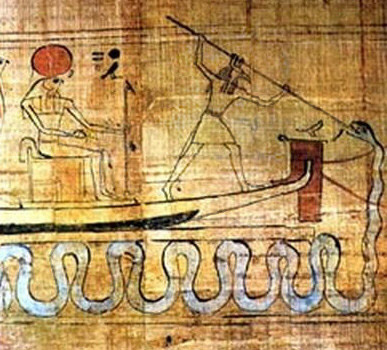
The Egyptian deity Apophis (also called Apep) was ‘the great nasty’ - the mother of all curses and also the mother of cursing techniques. It was normal to show Apep small, but he was actually a large snake. One technique of magic is to make things smaller – reduce them in size – because small things can’t be scary. Even in contemporary politics, making a small satirical image of leaders reduces their power.

Talking about something and naming it makes it powerful, but in Egyptian magic, mutilating the name took power away from it. One image depicted Apep with a flint knife cutting off a bit of a hieroglyph to reduce its power. Mutilation of images reduces its power and this continues in Coptic world and elsewhere.

Apep is a demonic energy. (Mogg said he wouldn’t call Apep a god as that is uncertain). Is there absolute evil? Or is it relative? Normally in ancient mythology, it is relative, but Apep bends that rule of ancient world as Apep represents absolute evil.

Image magic
It is possible to argue that the origins of magic relates to activity against Apep, the serpent of chaos.

Heka is the name of magic, to make magic, to replicate images. That is a good definition of magic. Pagans are very into images, it is definitive of paganism. In the Christian 10 commandments, the third commandment is, ‘Make no graven images.’ This was intended for Christians to distance themselves from Egyptians, who used a lot of images.

Circles and enclosures
One quality of defining magic - and cursing - is enclosing things. This could be seen like the magic circle in modern times. A temple does that, and building a square is more primeval than building a circle. The first thing the gods do when brought back to life in Egyptian myth is make a four-square building.

A cartouche is the drawing of a circle around a name to protect them. Or one can draw a circle around a building to protect it.

Spitting, licking and swallowing
These are archaic magical techniques. To spit upon something is easily understandable as magic and spitting on an image, for example, is a powerful action.

Binding and knots
These are ancient forms of magic from Egypt. In the Koran, the magician or exorcist is the blower of knots, to unravel them

The evil eye
One Egyptian image shows a wax ball being beaten. It represented the evil eye or ‘biting eye’, which is associated with snakes that were said to hypnotise victims. Beating a wax ball is magic to deflect the evil eye.

Apophis was thought to be dangerous to the Sun God Ra and the other gods because he has power of evil eye. Only one god can withstand it and that is Set. He is not affected by power of evil eye, perhaps because he has something in common with that power. Another rule of magic is to fight like with like.

One image shows Set with a hawk head and spear overcoming Apep. This is the origin of the image of St George defeating the Dragon, although it shows Set overcoming Apep.

Few people could read in the Ancient Egyptian world so books had pictures in. For example, in The Book of the Dead you just need the picture images to see what will happen in the afterlife.One picture from the book shows the Sun God Ra just before dawn (the most dangerous moment) with a huge snake below being speared by Set.

But Apophis is never actually killed. If you kill the devil you have to invent them again! Where else would you channel your anger? You would have to project it onto something or someone else, or a group of people. Apophis is about non-existence.

Colossal serpents exist in most mythology. There is Leviathan from Canaanite myth for example.
In the first societal breakdown after Old Kingdom in Egypt, there was some sceptical writing – saying that the building of the pyramids was a waste of time as people did not come back from dead.
It was a bad time in which rival warlords were trying to kill each other. This is the first time Apep (or Apophis) is mentioned. Magic itself developed in this period for protection and had a primacy it never had before.

A huge Egyptian book is called The Book of Overthrowing Apep. In the temples they cursed Apep every day. The technique uses a wax image of Apep to be spat upon. Wax was important, because when it is finally destroyed there is nothing left. If there is anything left, the bad thing will come back
The image was spat upon at several times throughout the day, then placed in the fire and trampled in the dirt. The words: “Fire be upon you Apep,” were repeated four times.

Apep has no temples we know of, but could be the remnant of an archaic serpent cult.
Mogg again framed the question as to whether Apep represented absolute evil or or whether things are still relative. He summed up by saying that his name emerges in time of hardship when Egyptians resorted to magic to protect themselves and possibly even invented magic at that time.

He said: “Egyptian religion essentially is magic.”

The photo at the top shows Mogg Morgan at the conference, the other two pictures are public domain images of Apep/Apophis.

Links and previous related posts
http://museumofwitchcraftandmagic.co.uk/
http://www.badwitch.co.uk/2017/05/a-weekend-of-cursing-at-museum-of.html
http://www.badwitch.co.uk/2017/05/pagan-eye-dolls-from-poppets-pins-power.html