Showing posts with label Mothering Sunday. Show all posts

Thursday, 7 March 2024

Poppet Craft: A Doll to Do Three Things at the Same Time

I confess, this isn't some wonderful magic that allows you to be in three places at once. I wish I had that power. However, I made this doll to combine a celebration of three very different events happening this week: World Book Day, International Women's Day and Mothering Sunday. 

Celebrating Being an Author

Today is World Book Day, which is all about the love of books. I made the doll in the picture to represent myself as the proud author of quite a few titles. I photographed my poppet surrounded by some of them published by Moon Books. In the Pagan Portals series I've written Candle Magic, Scrying, Guided Visualisations, Rounding the Wheel of the Year, and Poppets and Magical Dolls

My first novel, Erosion, is due to come out in April and I'm incredibly proud of the achievement. It's a Gothic tale set in 1987 - the year of the Great Storm - on the English coast. I'll be doing a book signing at Treadwell's in London on Saturday 6 April and it would be lovely to see anyone who wants to pop in and say hello. You can find the details here: https://www.treadwells-london.com/events-1/book-signing-erosion-of-friendship-dreams-and-the-edge-of-a-cliff-lucya-starza.

Celebrating International Women's Day

International Women's Day, on March 8, is a global celebration of women's achievements, and also an activism movement for greater equality and inclusivity. 

The pattern I used to sew my poppet was created especially for International Women's Day by Sew Jessalli. The doll honours diversity because she can be made in a variety of skin tones, there's an option to add glasses (like I did) and a headscarf as well as other clothing options. The pattern is available to download completely free from the Hobbycraft website here: https://www.hobbycraft.co.uk/ideas/how-to-sew-a-doll.html?

Although Hobbycraft includes a long list of materials it suggests you buy, I made my doll entirely from scraps of fabric, wool, thread, and filling that I already had. I also hand-sewed her rather than use a machine. The poppet's trousers are upcycled from one of my old pairs of holey leggings, to link her more closely to me. I made the top from a scrap of fabric in my mother's old sewing box, which leads me on to how my doll also helps me remember my mum.

Celebrating Mothering Sunday

In England, Mothering Sunday takes place at a different time of year from American Mother's Day. It's a custom dating back to the Middle Ages, and is always on the fourth Sunday of Lent. Back then it was a Christian festival when people were supposed to go to their "Mother Church" as well as visit their real mums and maybe give them some flowers. Nowadays most of us just do the latter unless, like me, our mums have passed on.

I always do something on this day to remember the happy times I shared with my mother. She taught me to sew and knit, and inspired my love of crafting. She also made dolls, which she sold to raise money for the charity Age UK. This year I honoured her memory when I made this doll myself, partly using materials from her old sewing box. 

Poppets

My book Pagan Portals - Poppets and Magical Dolls has lots of other suggestions for ways to use dolls for spells, seasonal celebrations and inspiration. Here's the description from the back cover: 

Poppets are dolls used for sympathetic magic, and are designed in the likeness of individuals in order to represent them in spells to help, heal or harm. Pagan Portals – Poppets and Magical Dolls explores the history of poppets and offers a practical guide to making and using them in modern witchcraft. It also covers seasonal dolls, from Brigid dolls, used in celebrations for the first stirrings of spring, to fairy dolls enjoyed in tree-dressing at Yuletide.
On Saturday 16 March I'll be teaching a workshop on poppet magic at Treadwell's Bookshop, 33 Store Street, Bloomsbury London, WC1E 7BS. The class starts at 1pm and tickets are £22 per person. You can find out more or book a place here: https://www.treadwells-london.com/events-1/poppet-magic-workshop

You can view Pagan Portals - Poppets and Magical Dolls on Moon Books' website, buy copies via Treadwell's and other pagan bookshops, or view it on Amazon. It's available in paperback or ebook.

Note: I earn commission from some links. This helps subsidise my blog at no extra cost to readers.

Tuesday, 27 February 2024

Rounding the Year: Camelia & Forsythia Blossom

The sight of forsythia blossom in my front garden fills me with joy every spring. It reminds me of my mum, who planted it there many years ago. It also shows me that things don't always turn out as badly as I fear they might. Back in 2016 I was told the forsythia would have to be removed so a crack in my garden wall could be fixed. I blogged about how sad I was about that, and you can read that post here

In the end, the wall got mended and the forsythia was spared. The bricks are starting to crack again, but I think I can live with a crack in the garden wall if the alternative is losing my lovely hedge that blossoms so cheerfully.

Camelias are also starting to bloom in my garden - early this year. They bring back memories of my mum too, as we planted that bush together. I always remember my mum when I see the forsythia and camelias in bloom, more than I do on Mothering Sunday, which is generally a few weeks later. 

English Mother's Day is on Sunday, 10 March in the UK this year, and has a different origin from American Mother's Day. We call it Mothering Sunday, and it takes place three weeks before Easter Sunday as part of traditional Lent customs.

You can see photos of my forsythia and camelia on this post. 

Join me for an online talk on spring folklore tonight

I'm giving an online talk called The Magic and Folklore of Springtime this evening, Tuesday 27 February, via the College of Psychic Studies. It starts at 7pm, with a recording available later. Tickets are £16/£14.  You can find out more details and book tickets here: https://www.collegeofpsychicstudies.co.uk/talks/myth-magic/the-magic-and-folklore-of-springtime/

Share your seasonal photos!

I recently started prompts to share seasonal pictures, art, crafts, words and other creativity. I'll continue this over the months ahead. I'd love to encourage readers to record what's happening in nature in various ways including photographs, journalling, drawing or painting and crafting.

Here are ways to share the things you're doing or what you see out and about as the wheel turns:

  • Leave a comment on this post about what you're up to
  • Find my prompts to share on my Facebook Page: Lucya Starza Pagan Portals Author
  • Share on Instagram or X (formerly Twitter) with the tag #RoundingtheYear

My book offers more ways to acknowledge the Wheel of the Year and celebrate the seasons in ritual, magic, folklore and nature. You can find it at estoeric bookshops and via my publisher Moon Books: https://www.collectiveinkbooks.com/moon-books/our-books/pagan-portals-rounding-wheel-year

Monday, 5 March 2018

Mothering Sunday: Christian or Pagan? Does it Matter?

Mothering Sunday, often shortened to Mother's Day - is a traditional day in English customs to bring our mum a bunch of flowers and maybe treat her to a nice dinner.

The day always falls on the fourth Sunday of Lent, three weeks before Easter Sunday. The middle Sunday of Lent has long been associated with mothers in the Christian calender; as on that day - Laetare Sunday - it was traditional for people to return home to their mother church.

Mothering Sunday was formalised in the UK in the early 20th century when a vicar’s daughter named Constance Smith read a newspaper report of a campaign in America to celebrate such a day across the Atlantic.

So far, so Christian.

However, there are some suggestions the festival had pagan antecedents. The 1959 edition of the Encyclopædia Britannica gave this description of Mother's Day: "A festival derived from the custom of mother worship in ancient Greece. Formal mother worship, with ceremonies to Cybele, or Rhea, the Great Mother of the Gods, were performed on the Ides of March throughout Asia Minor."

That's definitely pagan.

Of course, just because festivals to honour mothers happened in Ancient Greece and Rome, doesn't mean there is any direct link to the Christian festival. The fact that the happen at about the same time of year could just be coincidence.

American Mother's Day, in May, is considered a secular holiday.

But does it matter whether the festival is purely Christian or has pagan roots, or if other countries have secular days at different times of the year to honour mothers? Personally, when my mother was alive, I would always bring her a gift for Mother's Day and usually take her out for Sunday lunch. I did it because I wanted to make my mum happy.

The other issue is whether Mothering Sunday is too commercialised these days. It is estimated that close to £1.5 billion was spent on Mother’s Day in 2017. That figure includes money spent in shops and also dining and entertaining. It is clearly big business.

However, research suggests that mothers aren’t bothered about receiving a lavish gift on the day. Rather, they’d happily spend time with their children instead.

What are your thoughts on the matter?

The photo at the top shows the Four Mothers - a Roman carving at the Museum of London.

Links and previous related posts
http://www.fossilizedcustoms.com/mothersday.html
https://www.fungglobalretailtech.com/research/uk-mothers-day-2017-retail-preview/

Sunday, 6 March 2016

Remembering Mum on Mothers Day


Today, March 16, is Mothering Sunday - or Mothers Day in the UK. It is a difficult time for those whose mothers have passed on.

My own mum died a few years ago, shortly before Mothering Sunday. It felt as though every shop window and every advert I saw reminded me of my grief. But, as time went on and Mothers Days rolled around with the wheel of the year, I began to see the occasion as one on which to remember my mother and the happy memories I have of her, rather than an event to try to shut out entirely.

I usually go into the garden and pick daffodils to put next to a photograph I have of her on my desk. I also light a candle for her and chat to her as if she can still hear me, telling her about things that have happened and that I love her.

Many pagans believe in the importance of honouring our ancestors. Samhain is often seen as the most important festival on which to remember those who have gone before. That is something I do too - scrying for messages from friendly spirits from the Otherworld; ancestors of blood and place and tradition. But Mothers Day is reserved for talking with my mother.

Of course I can never be certain whether she hears me. Even if there is life after death we can't tell if those who have passed through the veil are listening to us. However, it is well documented that those who have lost loved ones can gain comfort from trying to communicate with them, even if all we are talking to is our own memories and our image of them in the place they still hold in our hearts.

Friday, 28 March 2014

Recipe: Egg, Mushroom and Thyme Turnover

Ever since my mum died, I've tried to avoid things relating to Mother's Day because they remind me of my loss, but something that happened earlier this week made me think that perhaps her spirit is still watching over me.

As I reached up to get a cookery book from the shelf, instead of just getting the one book I wanted a whole avalanche of recipes showered down on my head - cuttings from magazines, little cards picked up at the supermarket and many scraps of paper on which recipes had been jotted down. 

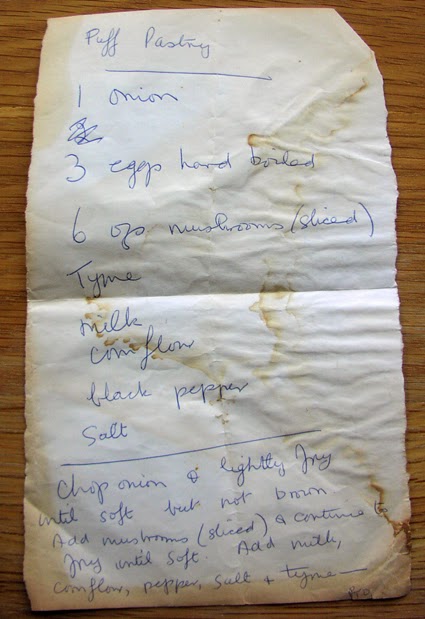
As I tidied them up to put them back, one of my mum's favourite vegetarian recipes fluttered out, scribbled in her handwriting on a piece of paper that had gone brown with age. It was a dish she cooked for me quite often if I came round for Sunday lunch. The recipe easily serves three people, I seem to recall. I thought I would share it here:

Egg, Mushroom and Thyme Turnover

You need:
Puff pastry
3 hard boiled eggs
6 oz mushrooms (sliced)
Thyme
Milk
Cornflour
Black pepper
Salt

Chop the onion and lightly fry until soft but not brown. Add sliced mushrooms and continue to fry until soft. Add milk, cornflour, pepper, salt and thyme. Cook until right [thick] consistency (stirring all the time). Remove from stove and added chopped hard boiled eggs. Put aside until cold.

Roll out the puff pastry into a big square. Put the mixture into the middle. Roll pastry over it and seal the edges with a little water. Make three or four cuts in the top with a blunt knife. Cook on a baking tray at regular 7 [Gas Mark 7]  until very... 

There was something crossed out after "very", but I couldn't quite read it, so I guess it will be a bit of trial and error to see how long it takes to cook. I wouldn't think it would take too long. At least modern ovens have a glass front so you can peer in and see if the pastry has puffed up and turned a nice golden colour.

I might try cooking this on Mother's Day in her memory, but I think it would also be a great vegetarian recipe to eat at Easter. 

Thursday, 20 February 2014

Review: You Can Heal your Heart

Heartbreak can come in many forms - obvious ones such as a break-up, divorce or bereavement, but also things like redundancy or retirement from long-term employment, the loss of a pet and from recognising that any stage of our life is over and that we must put it behind us.

A new book called You Can Heal Your Heart: Finding Peace After a Breakup, Divorce or Death, by Louise Hay and David Kessler, offers some gentle and common-sense advice about ways to recover from heartbreak.

Recognising that grief is real, and that part of getting over any loss is to grieve for it, Louise Hay and David Kessler explain that by telling ourselves positive affirmations we can learn to reach a state of peace. We can recognise the value of the past and learn lessons from it, but still enjoy all that life has to offer us in the future.

Positive affirmations are simple phrases that we can  repeat to ourselves as a kind of mantra. Three very generic ones that I like from the book are:  "I love life, and life loves me," "I have lived and loved," "I am healed."

I've used positive affirmations myself in the past, when times are difficult. My personal favourite positive affirmation - although not one mentioned in You Can Heal your Heart - is a quote from the historic anchoress Julian of Norwich: "All shall be well, and all shall be well and all manner of things shall be well." Those simple words remind me that things can get better, and usually do.

The chapter of You Can Heal your Heart that most struck a chord with me was the one on bereavement. My mother died nearly three years ago, on 9 March 2011. Whenever the anniversary of her death approaches I still start to feel sad. I also miss her a lot at the time of her birthday, at Yule, on Mothering Sunday and even at Pancake Day.

You Can Heal your Heart includes several stories about people who had lost their mothers and how they came to terms with it. What I realised from reading the book is that it is OK to recognise my grief and to shed a few tears even years after her death. It simply shows that I still love her. However, this year I will put a moment aside on each of those days to recollect a joyful time when she was alive, and I will say to myself: "I remember my mother with love".

You Can Heal Your Heartis published by Hay House.

Links and previous related posts
http://www.hayhouse.co.uk/
You Can Heal Your Heart: Finding Peace After a Breakup, Divorce or Death
http://www.badwitch.co.uk/2014/02/valentines-day-reading-you-can-heal.html
http://www.badwitch.co.uk/2013/06/review-honeymoon-effect-heaven-on-earth.html
http://www.badwitch.co.uk/2012/05/soul-centred-transform-your-life-with.html
http://www.badwitch.co.uk/2012/04/review-power-of-then-sages-of-past.html
http://www.badwitch.co.uk/2011/03/my-mother-has-died.html

Thursday, 7 March 2013

Sharing the Stories of our Family and Ancestors

One of my biggest regrets is that I didn't talk to my mother and father enough about their pasts. As a pagan, I like to think I honour my ancestors - yet my family photo album has pictures of my parents when they were younger with people I don't know and places I cannot identify.

A new study by a company that produces journals for recording family history information shows most of us spend little or no time talking to older relatives, including our parents, about their lives. This means that years of family stories could be lost to future generations.

Three quarters of those who responded to the survey admitted they spend little or no time talking to older relatives about their lives and the family stories of their parents.

More than half of us do not talk to our parents or grandparents about our family heritage, while close to 30 percent have never talked to their mother about their own lives. Even more have not chatted to their father about what they did when they were young.

Close to 40 percent of us don’t know how our parents met, 48 percent don’t know when they met and 86 percent don't know how their  or where their dad proposed to their mum, if they are married. More than 60 percent of us don’t know what our parents’ hobbies were when they were children, 40 percent don’t know where our grandmother or grandfather were born and almost a third don’t know our grandmother’s full name.

However, according to the survey it seems that most of us think it’s important to know about the stories from our relatives’ lives to capture this information before it is lost forever. We just don’t seem to be following this through. The results of the survey showed that the older one gets, the stronger these feelings become.

One way to learn more about your relatives before it is too late is to ask them to write down their stories in a journal. The ‘from you to me’ journals, pictured above, are designed to give as gifts to help families do this. The books contain inspiring questions and prompts - as well as space to write the answers - to help capture stories about the people close to you

Rhoda Breakell, head of Genes Reunited, commented on the ‘from you to me’ research results: "The amount of people who don't spend time listening to their parents and grandparents about their family heritage is surprising. We feel it's so important that people listen to the older generations within their families before their stories are lost forever."

As someone who has lost her own mother, I think this is a lovely idea. And with Mothering Sunday (often called Mother's Day) coming up, I think giving your own mum one of these journals as a gift would make an unusual but very appropriate present, especially for a pagan.

Links and previous related posts
www.fromyoutome.com
http://www.badwitch.co.uk/2013/02/pancake-day-is-sad-time-for-me.html
http://www.badwitch.co.uk/2011/02/festival-of-week-parentalia.html
http://www.badwitch.co.uk/2012/10/review-druidry-and-ancestors.html
http://www.badwitch.co.uk/2008/03/mothers-day.html

Friday, 1 April 2011

Nanshe: Goddess of Orphans and Justice

This Sunday is Mother's Day in the UK. Having recently lost my mum I realised just how difficult this time of year is for those who have no mother - particularly children. So I have chosen Nanshe Goddess of Orphans, Widows and Social Justice - as well as being a mother goddess - as The Bad Witch's Goddess of the Week.

In Sumerian mythology, Nanshe was a popular goddess, with many roles. Although she was primarily a goddess of fertility and fishing, she was also a goddess of prophecy through dreams and social justice - particularly championing the causes of widows and orphans.

One of the verses in an ancient hymn to Nashe, translates as: "She is concerned for the orphan and concerned for the widow. She does not forget the man who helps others, she is a mother for the orphan; Nance (sic), a carer for the widow, who always finds advice for the debt-slave; the lady who gives protection for refugees. She seeks out a place for the weak."

As that hymn suggests, Nanshe also gave advice to those in debt and took in refugees from war-torn areas.

Although Nanshe might be a very ancient goddess, it seems to me that a prayer to her this weekend could be very appropriate. Not only is this a particularly difficult time of year for orphans, we are also living through a year of considerable social unrest and injustice. Many people are suffering debt, and there are many refugees from strife-torn lands. Nanshe, I call upon you, please give your aid to those who need your comfort and protection...

I had trouble finding a picture of Nanshe. She appears as the Justice card in the Babylonian Tarot by Sandra Tabatha Cicero, but I don't own the deck and could only find an image of the cover of the boxed set, plus a few of the other cards in it. I might have to go and buy a copy...

Links
http://www.badwitch.co.uk/2008/03/mothers-day.html
http://www.badwitch.co.uk/2009/03/magna-mater-goddess-of-week.html
http://www.pantheon.org/articles/n/nanshe.html
http://www-etcsl.orient.ox.ac.uk/section4/tr4141.htm
http://en.wikipedia.org/wiki/Nanshe
Babylonian Tarot (deck & book) by Sandra Tabatha Cicero

Tuesday, 9 March 2010

A Mother Goddess for Mother's Day

With Mother's Day coming up this Sunday, I thought I would look around for some suitably pagan gifts and I found this jigsaw of the Egyptian Mother Goddess Mut from Mary Evans Picture Libary (pictured top right).

Mary Evans also does a framed print of Mut (pictured below left).

Mut means "mother" in ancient Egyptian, and she was worshipped widely in Thebes and Luxor as a goddess of motherhood. Mut has already been my Goddess of the Week, but perhaps she deserves the title a second time round this week.

Both the jigsaw and print show Mut looking like a beautiful woman, but in Ancient Egypt she was often depicted with the face of a vulture. The jigsaw shows Mut pouring water from a sycamore tree over a deceased person and his soul to help him on his way in the afterlife.

Hmmm... vulture-headed women? funeral rites? Perhaps not that appropriate for Mother's Day gifts after all.

You could even be forgiven for wondering if, perhaps, I don't get on that well with my mum if I'm thinking of giving her those pictures as presents. Perhaps I should shut up right now before I come up with something even more unsuitable...

Maybe it would be best just to give mum the traditional a bunch of flowers this Sunday.

The 300-piece jigsaw puzzle measures 17x12 inches and is available from Amazon at £17.36. The picture of Mut from Mary Evans costs £39.14.

Thursday, 19 March 2009

Magna Mater - Goddess of the Week

Because this Sunday is Mother's Day in the UK, I decided to pick Magna Mater - or the Great Mother - as The Bad Witch's Goddess of the Week.

The Great Mother has been worshipped in many different forms since neolithic times, under many different names. She is Mother Earth, she is seen in the mountains and she is the mistress of the animals. One name for her is Cybele, the Phrygian "Mountain Mother". Others identify her with Greek Gaia, "The Earth".

She is generally seen as a fertility deity and it is appropriate to honour her in the spring when animals everywhere are generally going about their ancient rituals of courting, shagging and breeding.

The picture shows a chocolate Mother Goddess made with a Mother Goddess Chocolate Mould. This is sold by the online store Pagan Magic and costs £7.99. Makes the Mother Goddess look good enough to eat!

Links
http://www.badwitch.co.uk/2008/03/mothers-day.html
http://hem.bredband.net/arenamontanus/Mage/magna.html
http://en.wikipedia.org/wiki/Cybele
http://pagan-magic.co.uk/shop/mother-goddess-chocolate-mould-p-6256.html?ad=badwitch

Saturday, 1 March 2008

Mother's Day

Most countries, and most civilisations since the ancient Egyptians, have put aside a day to honour mothers, but very few celebrate it on the same date. For example, Americans will be celebrating Mother's Day in May.

In the UK and Ireland, Mother's Day is more traditionally called Mothering Sunday and is a Christian holy day, which takes place on the fourth Sunday of Lent. This is believed to have begun in the 17th century when Christians would visit their "mother church" annually. It also meant that on that day most mothers would be reunited with their grown-up children who may have moved away from home.

Unlike many Christian holy days, there is little evidence that Mothering Sunday was plonked on top of an existing pagan festival. However, most pagan religions hold motherhood - and the Mother Goddess - in very high esteem. The ancient Egyptians held an annual festival to honour Isis, who was regarded as the mother of the pharaohs. Ancient Greeks honoured Rhea, the mother of the gods. The Roman root of Mother’s Day can be seen in the celebration of the Phrygian goddess Cybele, or Magna Mater (Great Mother), who is a version of Rhea.

In the USA, Mother's Day is always the second Sunday in May because it is when, after the American Civil War, Julia Ward Howe wrote the Mother's Day Proclamation as a call for peace and disarmament. In 1914 President Woodrow Wilson declared that day as a national holiday for American citizens to show the flag in honour of mothers whose sons had died in war.

This holiday became very popular and was commercialised by the greeting card company Hallmark. By the mid 20th century American Mother's Day became fused with British Mothering Sunday, which had declined as a religious festival, and turned it into the event we know today - a time to send a card and a bunch of flowers to your mum, rather than a day to go to church.

For more information about Mother's Day, visit: