Showing posts with label Bunhill Fields Burial Ground. Show all posts

Thursday, 31 October 2013

London Necropolis: Abney Park Cemetery & Arboretum


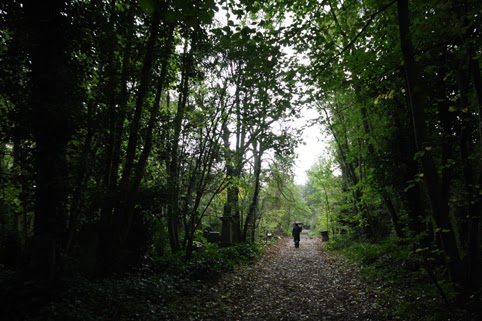
There's nothing quite like a visit to a Gothic graveyard to get in the mood for Halloween - particularly when a storm is brewing. Last weekend, under darkening skies, I visited Abney Park Cemetery in North London.

Abney Park is one of London's so-called Magnificent Seven Cemeteries, which were built in the Victorian era to relieve overcrowding in the city graveyards. The other six are Highgate, Brompton, Nunhead, West Norwood, Kensal Green and Tower Hamlets. Having visited four of them at Halloweens past, I'm now on a mission to see all seven. My husband decided that Abney Park was the next to visit, mainly because he is something of a fan of the eponymous steampunk band.

Abney Park was instated as a cemetery in 1840, but was also a semi-public park arboretum and garden. It took over from Bunhill Fields Burial Ground as the main cemetery for non-conformists and was planned as a landmark for religious tolerance as well as for botanical education. The site was never consecrated, yet by the 20th century it was full of the unconventional dead. Following years of neglect, Abney Park was saved by local people and turned into an atmospheric nature reserve.

A leaflet I picked up at the visitor centre by the grand Egyptian-style entrance was a guide to the Veteran Trees of Abney Park. One of these trees, I discovered, was a catalpa - and you can see that in the photo to the left.  I've been fascinated by catalpa trees ever since I saw one outside Rochester Cathedral earlier this year. This time, I could actually see one in leaf.

Another interesting tree in Abney Park is a dead trunk that has been carved with symbols including the sun and the moon (pictured right). I couldn't find much information about it on the leaflet - if you know anything more, do leave a comment.

In the centre of Abney Park Cemetery stands a magnificent Gothic chapel, which is sadly ruined and currently fenced off. I thought about climbing the wall and exploring inside, but as I circled around the perimeter there was a  flash of lightning, a clap of thunder and rain started to fall in earnest. With a storm fit for a horror movie opening sequence raging around me, I took it as an omen to leave the graveyard as quickly as possible.

Abney Park Cemetery is on Stoke Newington High Street, London N16 and is really easy to find with plenty of buses stopping just outside. There's also a rather good pub just over the road called the Jolly Butchers - it sells a wide range of real ales, real cider and delicious sausages. Just the place to shelter from the storm - and maybe hole up come the zombie apocalypse :)

Links
The Magnificent Seven: London's First Landscaped Cemeteries
Ancient World
http://www.abneypark.org/
http://www.badwitch.co.uk/2012/10/london-necropolis-victorian-cemetery.html
http://www.badwitch.co.uk/2013/05/the-rochester-catalpa-tree.html

Saturday, 9 October 2010

Angels and Demons of Peckham Rye

People living near Peckham Rye, in South London, are complaining about being woken in the dead of night by what they call "weird demonic chanting" coming from the depths of Peckham Rye Common.

One resident wrote on the East Dulwich Forum: "Did anyone hear this last night at about 3am? Really scary - could hear it from our flat. What's all that about?"

Another replied: "It happens about three or four times a week, always 3AM, and drives me insane."

Others have also heard the strange sounds, and have attributed it to such things as a Black Mass or Faustian performances.

However, one skeptic asked: "What makes you think it is demonic?" Which is, of course, a very sensible question.

I assume - hopefully correctly - that very few people in Peckham are actually in the habit of conversing with demons - or, indeed, are demons themselves.

Peckham Rye is certainly considered a dangerous place to live – according to Wikipedia "Peckham is a high-crime area with high levels of gang violence". But I'd guess the break-ins, muggings and gang fights the area is notorious for are committed by human criminals rather than denizens of Hell or any other infernal plane.

Wikipedia also provides some interesting snippets about the occult history of Peckham Rye - but interestingly that has more to do with angels than demons. It states:
"In 1767 William Blake visited Peckham Rye and had a vision of an angel in a tree. In 1993, at the request of the Dulwich Festival, artist Stan Peskett painted a mural of Blake's vision next to the Goose Green playground in East Dulwich."
Could it be possible that the mysterious chanting is, in fact, an attempt to contact Blake's tree-hugging angel?

I was once invited to take part in an angelic magickal ritual from a Rennaissance grimoire - though not on Pekham Rye Common I hasten to add.

This primarily involved standing robed in a candlelit circle and chanting the names of angels, but, I would have to say, that there was nothing particularly angelic-sounding about those names. They weren't just the names of famous angels such as Gabriel - they were little known ones with names that were unfamiliar and hard to pronounce.

I've never taken part in any demonic ritual - from dusty old grimoires or otherwise - but I'd hazard a guess that one might involve chanting the names of demons, which would sound just as unfamiliar and hard to pronounce as angels' names.

Out of curiosity, and to do a rough comparison, I decided to look up the names of angels and demons on Wikipedia. Sure enough that wonderful source of information had a page of each and, as I suspected, I couldn't have told an angel from a demon just from its name. Have a look for yourself at http://en.wikipedia.org/wiki/List_of_theological_angels and http://en.wikipedia.org/wiki/List_of_theological_demons and see what you think.

However, if I was inclined to look for conspiracy theories, I might think that this ritual on Peckham Rye Common was simply a small part of some terrible master plan.

Remember that strange stone I found by William Blake's grave in Bunhill Fields just over a year ago?

The stone was surrounded by red rose petals and on it was written the words:
"Blake Rising
Bunhill Fields
Weds 12 August
1pm"
At the time I was fearful of confronting zombie Blake, summoned from his grave by a spot of lunchtime necromancy. But perhaps it was just the start of something far worse - a plan to raise the visionary artist as an undead vampire to rule over London in some twisted version of Jerusalem built on dark, satanic mills.

Perhaps it would be a good idea to investigate those other areas of London associated with Blake and find out if any demonic chanting or signs of necromantic rites have been discovered there too.

Of course, if you happen to know what's really going on at Peckham Rye in the dead of night, do let me know by leaving a comment or emailing badwitch1234@gmail.com

The picture shows Blake's The Great Red Dragon and the Woman Clothed with Sun (1805)

Links
http://www.eastdulwichforum.co.uk/forum/read.php?5,543811,543938
http://www.badwitch.co.uk/2009/08/blake-rising-spot-of-lunchtime.html
http://en.wikipedia.org/wiki/Peckham
http://en.wikipedia.org/wiki/List_of_theological_angels
http://en.wikipedia.org/wiki/List_of_theological_demons
http://en.wikipedia.org/wiki/William_blake

Thursday, 11 March 2010

Springtime haiku


I was asked to write a poem to recite at a spring ritual. Not being very good at learning lots of lines, I decided to write a haiku - a short poem with 17 syllables. Here it is:

Spring
Under a stormy sky
clouds scud and trees sway.
The yellow crocus blooms.

Haiku are often written about the seasons, so it was quite apt. Some time ago I wrote a poem about the seasons that was similar to a series of haiku - hopefully this one has the correct number of syllables.

I took the photograph of crocuses at Bunhill Fields Burial Ground, while I was writing the poem. I often find a visit to Bunhill Fields inspires me when I need to be creative as it is such a lovely city park - the resting place of many of London's ancient and prestigious dead as well as a haven for wildlife and flowers.

I know the picture quality is rubbish - I only had my phone with me to use as a camera.

Links
http://en.wikipedia.org/wiki/Haiku
http://www.badwitch.co.uk/2010/01/coldest-night.html
http://www.badwitch.co.uk/2008/03/meditations-on-element-of-air.html
http://www.badwitch.co.uk/2009/02/crocuses-for-love-insight-and-magic.html

Tuesday, 12 January 2010

The coldest night...

We still seem to be gripped in Narnia-like winter with snow thick on the ground and fresh falls masking slippery ice.

Several times over the past week I've seen news headlines proclaiming "The Coldest Night of the Year". It certainly seems a time when any sensible creature - human or otherwise - would want to be hibernating rather than venturing outside.

Unfortunately, unlike in Narnia, Christmas has been and gone but winter is still here and the summons back to work can't be avoided if one wants to earn enough to pay the bills and eat.

One lunch hour last week I went for a wintry stroll around London's Bunhill Fields Burial Grounds. Part of the ancient graveyard is a public park and the lane running through it is often used by pedestrians as a shortcut so it is usually a busy place, but on that day it was almost deserted.

I found myself wandering alone among the silent tombs with only a hopeful squirrel, a few pigeons with their feathers puffed up against the cold and a solitary sorrowful magpie for company.

On my iPod, while standing on freezing station platforms waiting for delayed trains home, I've been listening to The Coldest Night [The Crow & the Salmon] from Rigantona's Daughters by Scott Jasper and Susan Garlick:

"Has there ever been a night as cold as this?
Has the land ever been so frozen deep in winter's grip?
If so, it must have been far and long ago,
I call to seek the answer from one who might know..."
The song is about the coldest night in history, far colder than our winters these days and only recalled in legend or perhaps in ancestral memory of the oldest animals of our lands.

In Irish and Welsh tales, the crow and the salmon are mythological creatures of cunning and wisdom. The song The Coldest Night describes a battle between them that is both a physical struggle for survival in a land where water is frozen and food is scarce, and a magical contest of wits between the king of water and the queen of air for knowledge that comes from deep within the land.

Well, if I was seeking ancient creatures of wisdom, I was certainly out of luck at Bunhill Fields Burial Ground. There weren't any crows about, although I guess the magpie might be considered their mischievous cousin. Pigeons certainly aren't known for their intelligence and the grey squirrel is a recent American visitor to our shores. I suspect the closest salmon was probably in a tin on a supermarket shelf.

But there was one thing I realised as I watched the magpie, pigeons and squirrel trying to find food and shelter from the cold in the frozen graveyard - wild creatures can do with a bit of help to survive this bitter winter.

So, over the weekend, I didn't entirely hibernate inside my centrally-heated home, I ventured outside with scraps of food and bird seed for any of the birds, squirrels, foxes and other wildlife in my garden.


Links
http://www.dragonflymoononline.co.uk/Music_CDs.htm
http://www.badwitch.co.uk/2008/02/green-and-pleasant-land.html
http://www.badwitch.co.uk/2009/08/blake-rising-spot-of-lunchtime.html

Wednesday, 18 November 2009

Some bedside reading

My partner is laid up in bed with a bad back, and I must say he is getting a bit crotchety with the pain and enforced boredom.

What's more, he ran out of books to read.

His favourite fiction at the moment is Mike Carey's supernatural noir series of Felix Castor books, about an exorcist-turned-detective set in a version of modern day London thick with ghosts, zombies and sinister plots. But my partner had just finished reading the most recent one - The Naming of the Beasts - and didn't have anything else he fancied starting. So, I popped down to my local library to see what I could find.

I wasn't convinced I'd find him anything he'd like. It's always tough choosing what to read after you've just finished the latest book in your favourite series. And I'd have to agree that the Felix Castor books are very good.

Perhaps I'm biased as they are set in my own home city of London and show such a wonderfully intimate knowledge of the capital that you can easily visualise the streets, buildings and even back alleys where Mike Carey sets his books' action. One of the places Felix Castor is often depicted visiting is Bunhill Fields cemetery - London's oldest graveyard - which is, incidentally, a place I often visit in my lunch hours from work, to sit and read a book.

What my local library did have was the Dresden Files series of books, by Jim Butcher, about a wizard-turned-detective in modern-day Chicago. My partner hadn't read the latest in that series so I was in luck finding something suitable.

But I am also frequently surprised at the good range of books on magic, mythology and spirituality at my local library, which is only a small branch.

On the shelf entitled New Books, I saw a lovely hardback called Myths and Legends by Philip Wilkinson. This is a large book with lots of beautiful pictures and photographs and is the kind of thing that is a joy to dip into. It covers the myths of Europe, South and East Asia, Africa, The Americas and Oceania.

Although you could criticise it as being a bit of a coffee table volume, I don't think that is necessarily a bad thing. It might not go into great depth on any one area but it is full of fascinating tales and information.

I'm going to use it to pick The Bad Witch's God or Goddess of the Week until I have to take the book back - that is if I can wrest it from my partner, who seemed more interested in browsing through it than in reading the Dresden Files book I'd picked for him.

Links
http://www.dorlingkindersley-uk.co.uk/
The Devil You Know: A Felix Castor Novel
The Naming of the Beasts: A Felix Castor Novel
Myths and Legends
Storm Front (Dresden Case Files)
Small Favour (Dresden Files 10)
Myths and Legends
http://www.badwitch.co.uk/2009/08/blake-rising-spot-of-lunchtime.html
http://www.badwitch.co.uk/2009/11/friday-13-unlucky-for-some.html
http://www.badwitch.co.uk/2009/08/history-of-magic-in-modern-age.html

Friday, 21 August 2009

Blake Rising - a spot of lunchtime necromancy?

Walking through Bunhill Fields Burial Ground yesterday lunchtime, I saw a curious stone, a burnt stub of a candle and a scattering of red rose petals.

"How lovely," I thought. "Someone has been honouring the grave of William Blake."

I went a bit closer to take a picture, but when I read what was on the stone I became just a little concerned at the phrasing of the words.
"Blake Rising
Bunhill Fields
Weds 12 August
1pm"
Rather than simply showing their respects to London's visionary artist and poet, was the perpetrator of this ritual actually hoping he would rise from the grave? Was this a spot of lunchtime necromancy?

While I admire Blake's creative spirit, I'm not sure I want to encounter his undead lumbering corpse next time I take my sandwiches and sit on a bench at Bunhill Fields in my break from work.

Perhaps I should take along a packet of that pink Himalayan salt I wrote about a few weeks back to ward myself from any rotting zombies I may meet.

But if I do, I will certainly write all about it on A Bad Witch's Blog.

Links:
http://www.badwitch.co.uk/2008/02/green-and-pleasant-land.html
http://www.badwitch.co.uk/2008/08/invasion-of-giant-slugs.html
http://www.badwitch.co.uk/2009/07/in-pink-with-pinch-of-salt.html

Friday, 15 February 2008

William Blake in London: A Green and Pleasant Land

The day before yesterday was, I read in the paper, the hottest February 13 on record.

I'm not surprised. I spent my lunchtime on Wednesday sitting in a lovely enclosed garden a short walk from where I work.

The garden is a peaceful haven amid the office blocks and busy city streets but it was the first time this year it has been warm enough to sit there for more than few minutes without wearing my gloves and turning up my collar against the cold. The sun was out, one tree was thick with white blossoms and others were sprouting tiny green buds. Birds chirruped among the crocuses. It was hard to make myself return to the office and I thought how perfect it would be if it was like that on Valentine's Day.

Except that it wasn't.

February 14 was overcast and bitterly cold. More like a normal February day, in fact. So, instead of spending my lunch hour sitting in a lovely spring garden I went for a walk.

I had thought of engaging in some Valentine's Day retail therapy but, for some reason, my feet lead me instead to Bunhill Fields Burial Ground.

You might think a cemetery is a strange place to go on Valentine's Day, and I admit I felt I was giving in to my inner goth when I walked through the wrought iron gates, but I don't regret it at all.

Bunhill Fields has been a burial ground for more than a thousand years and the name is derived from 'Bone Hill'. It was designated as a public open space in an 1867 Act of Parliament and, as a leaflet I picked up says, "The four hectares of Bunhill Fields are an oasis of calm and greenery in a busy, congested locality just north of the City of London's Square Mile."

It was the perfect antidote to the commercialised festival of love that is February 14 in our modern world - the tawdry pink tat in every shop window, the flower sellers hawking hothouse roses for £30 a bunch on street corners and the newspaper adverts telling us how we still aren't too late to book up an expensive evening for ourselves and our loved one.

At the centre of Bunhill Fields Burial Ground I came across the gravestone of the artist, poet and visionary William Blake and his wife, Catherine. I hadn't realised it was there at all. When I stopped to photograph it, I saw that people had left offerings - coins, leaves, even a chocolate bar. I felt humbled. In the heart of a bleak and cold part of London people were showing their love for someone who rejected greed and commercialism and who dreamt of an England that was a green and pleasant land.

Bunhill Fields is between City Road and Bunhill Row, London. The nearest stations are Old Street and Moorgate.

Visit: www.cityoflondon.gov.uk/corporation/living_environment/open_spaces/