Showing posts with label myths. Show all posts

Tuesday, 17 March 2026

Flower Folklore: Hyacinths and a Tragic Love Story

Hyacinths always bloom in my garden just after the first daffodils and before the bluebells come out. I took this photo yesterday and was reminded of the tragic love story associated with this beautiful flower.

In Greek mythology, Hyacinthus, prince of Sparta, was Apollo's  boyfriend. They were devoted to each other and spent all their time together, sharing enjoyment of music, divination, and sports - all things Apollo excelled at, of course. It was the latter that caused the tragedy.  

Hyacinthus went to catch a discus Apollo had thrown in a friendly contest, but it bounced up and killed the mortal. Apollo was devastated as his lover died in his arm. He tried everything to restore him to life, but all he could do was create a beautiful flower from Hyacinthus' blood.

However, I should probably also say that the flower we currently call hyacinth is probably different from the one mentioned in the mythological story, as that was purple and described as having a symbol of sorrow on the petals. It might instead have been larkspur, delphinium or even a type of gladiolus. 

Magical uses include love spells and anything to do with LGBTQ+ relationship, as well as for help overcoming grief and loss. In aromatherapy, hyacinth oil is sometimes used to help with stress, depression and tiredness. It can also aid deep sleep.

Warning: Don't eat any of the plant as it is toxic.

Some other spring flowers are also associated with tragedy in mythological tales, including daffodils, which I wrote about last month.

Thursday, 19 February 2026

Rounding the Year: Daffodils, Narcissus & a Tragic Tale

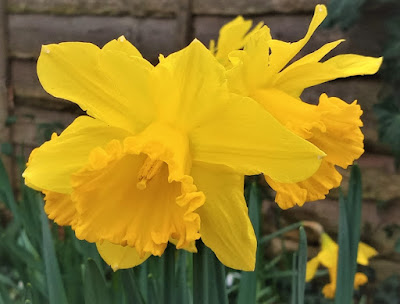
Daffodils are blooming in my garden again. They're a bit earlier than last year, but I'm pleased to see their bright yellow buds. Another word for daffodil is narcissus. That's the name of the Greek mythological character who fell in love with his own reflection, and associated with the term narcissism, meaning someone very self-centred. 

However, the full version of the ancient tale is more complicated and nuanced. Narcissus was loved by both a young woman called Echo, and a young man, Ameinias, but was unable to reciprocate the feelings for either. Echo wasted away, while Ameinias called on the goddess of revenge, Nemesis. She cursed Narcissus that whoever he did love wouldn't be able to return the affection either. This came true, but his passion for his own image burned so brightly he was transformed into a golden flower.

It's a sad story, isn't it?  But it does perhaps offer the message of accepting that not everyone we desire will necessarily share the same feelings. Don't go cursing someone just because they don't fancy you. Love can be bittersweet, but keep the tragedy in fiction please.

As much as I enjoy being reminded of a good tale, I also love to see the flowers at this time of year, which can be bitterly cold even though beautiful flowers are brightening the days.

Share your Pictures

Since my book Rounding the Wheel of the Year  came out I've been inviting people to share seasonal pictures, art, crafts, words and other creativity. I'd love to encourage readers to record what's happening in nature in various ways including photographs, as well as other seasonal journalling, musings, drawing, painting and crafting.

Here are ways to share the things you're doing or what you see out and about as the wheel turns:

  • Leave a comment on this post about what you're up to
  • Find my prompts to share on my Facebook Page: Lucya Starza Pagan Portals Author
  • Share on Instagram with the tag #RoundingtheYear

Where to find Rounding the Wheel of the Year

My book offers more ways to acknowledge and celebrate the seasons in ritual, magic, folklore and nature. You can view Rounding the Wheel of the Year on Amazon, find it at esoteric bookshops or via my publisher Moon Books: https://www.collectiveinkbooks.com/moon-books/our-books/pagan-portals-rounding-wheel-year

(Please note: I earn commission from some links.)

Other previous Related Posts
https://www.badwitch.co.uk/2026/01/rounding-year-when-snowdrops-bloom.html
https://www.badwitch.co.uk/2026/01/rounding-year-flower-of-love-hope-or.html
http://www.badwitch.co.uk/2025/09/rounding-year-when-do-you-think-autumn.html
http://www.badwitch.co.uk/2024/01/rounding-year-sharing-seasonal-pictures.html
http://www.badwitch.co.uk/2024/03/rounding-year-too-soon-for-silver-birch.html

Friday, 24 October 2025

Books: Pantheon - The Greeks - Magic & Mythology

Pantheon: The Greeks is part of a series published by Moon Books exploring different religious traditions and beliefs in the ancient world. This book by Irisanya Moon is officially published in a few weeks' time. It covers the basics of Greek mythology to ground readers and practitioners in history, mythology, cosmology, ritual, celebrations, rituals, prayers, and magic, as well as gods, goddesses, and other beings. I was lucky enough to read an advance copy and I wrote this endorsement:

“A brilliant resource on Ancient Greek deities, mythology, and history. Irisanya Moon bridges the gap between devotional works, retellings of heroic epics, and academic studies. This book is packed with useful information aimed at modern pagans. It offers material to use in spiritual practice as well as being a concise reference book. Pantheon: The Greeks is also a delight to dip into purely for pleasure.”

Irisanya Moon  is an author, witch, international teacher, poet, and Reclaiming initiate.

You can view Pantheon: The Greeks on Amazon.

(Please note, I earn commission from some links)

Previous related posts
http://www.badwitch.co.uk/2024/08/book-review-pagan-portals-norns.html
http://www.badwitch.co.uk/2022/02/interview-irisanya-moon-reclaiming.html
http://www.badwitch.co.uk/2025/10/rounding-year-my-book-is-two-years-old.html
http://www.badwitch.co.uk/2025/10/su-jolly-i-met-kent-artist-who.html

Friday, 14 April 2023

In the Labyrinth: Who Sat on the Knossos 'Throne'?

The chair pictured here is a wooden copy of the stone "throne" discovered by archaeologist Sir Arthur Evans at Knossos in 1900. It's on display at the Labyrinth: Knossos, Myth and Reality exhibition at the Ashmolean in Oxford. 

As with many of Evans' finds, there's controversy over his intepretation. He believed it was the throne of King Minos of the Greek myth. Other seats - wider and without backs - were also discovered. According to the audio guide I listened to while I was at the museum, Evans said these must have been for women because woman have larger buttocks than men. I will admit I burst into giggles when I heard that. I mean, fat-bottomed girls might make some people's world go round, but few of us need particularly wide chairs!

Later archaeologists think the stone "throne" might more likely have been used by a priestess rather than a male king. It also probably dates from a period of time much later than any in which the tale of King Minos could have been based. The exhibition explains the problematic nature of Evans' interpretations and his reconstructions at Knossos, in which he used a lot of imagination to try to make the rooms he discovered fit with mythology. 

Yesterday I blogged about the Labyrinth and the art and objects in the first room at the exhibition. I'll be sharing some more of my photos and thoughts on it in the future.

Labyrinth - Knossos, Myth and Reality is on at the Ashmolean Museum, Oxford, until 30 July. Full price tickets are £15.30. There's also a book accompanying the exhibition.  

Thursday, 13 April 2023

Into the Labyrinth: The Knossos Exhibition's First Room

"The Labyrinth in Greek myth was a maze designed for King Minos to house the monstrous Minotaur," is the introduction on the first wall at the Ashmolean Museum's latest exhibition, The Labyrinth was said to be on the Island of Crete, at Knossos. However, as the two objects on either side of those words show, there are different interpretations of what a labyrinth is. On one side we have a reconstruction of an ancient tile showing a maze-like puzzle of routes, on the other is 21st century art showing a design with a single twisting path from the edge to the centre. That art is from London's Green Park Underground station, in the series I blogged about recently.

The first room at Labyrinth: Knossos, Myth and Reality retells the tale of the Minotaur using objects from the ancient world, including a Roman statue of the bull-headed monster, and an animated video with storytelling. Other items include Greek and Roman coins, with large-scale reproductions, showing labyrinths and demonstrating how much these later inhabitants of Crete embraced the myth. 

However, there are still mysteries about what truth lies behind it, and people long searched for the actual labyrinth or maze. In 1878, Cretan archaeologist Minos Kalokairinos found evidence of a Bronze Age palace on Crete. His work was controversially taken over by British archaeologist Sir Arthur Evans, who excavated there in the early 20th century. Evans' interpretations of what he found, and his partial reconstruction of the buildings, are highly controversial too. 

Archaeologists are still excavating the site and finding out new things about the people who lived on the island over 9,000 years. Further rooms in the Ashmolean's exhibition explore the history of the excavations as well as what was found, and look at recent discoveries that might hold clues as to the real meaning of the tale of the Minotaur. I'll be blogging more about that in the future. 

If you've been following my blog, you'll know I've long been fascinated by labyrinths in their various forms. As well as writing about the art on the Underground, I've reviewed a few books on the topic and walked Julian's Bower. You can see some links to other posts below.

Labyrinth - Knossos, Myth and Reality is on at the Ashmolean Museum, Oxford, until 30 July. Full price tickets are £15.30. There is also a book accompanying the exhibition, which you can see on Amazon.  

Previous related posts
http://www.badwitch.co.uk/2022/10/book-review-labyrinth-walking-radiant.html
http://www.badwitch.co.uk/2023/02/review-wanderland-search-for-magic-in.html
http://www.badwitch.co.uk/2013/10/walk-labyrinth-at-mind-body-soul-event.html
http://www.badwitch.co.uk/2012/10/pagan-eye-labyrinths-of-earth-and-fire.html

Friday, 4 March 2022

Pagan Eye: Daffodils Blooming in my Garden

The sight of daffodils blooming in my garden always cheers me up. That's something I wrote more about yesterday at the Moon Books Blog. However, there's also a somewhat grimmer aspect to them in mythology.

Daffodils are members of the genus Narcissus. In Greek mythology, it was originally the name of a man who only loved himself. He broke the heart of the nymph Echo who wasted away until only her echo remained. Nemesis, Goddess of retribution, turned Narcissus into the flower. I'm sure many of us can think of a real-world narcissist or two who could be turned into a flower to do less harm to those around them...

There's also lots of positive folklore related to daffodils. Leaving them growing naturally where you find them is supposed to bring good luck. It is okay a few to bring indoors where permitted, perhaps to decorate a springtime altar. Just don't trample all over the ones that are left or take the lot! 

I took this photo yesterday as my flowerbeds are bright with them. Walking among them helped take my mind off the doom and gloom in the world. If you want to send me a photo for a Pagan Eye post, please email it to badwitch1234@gmail.com Let me know what the photo shows and whether you want your name mentioned or not. For copyright reasons, the photo must be one you have taken yourself and you must confirm that you are submitting it for A Bad Witch's Blog.

Links and previous related posts
http://www.badwitch.co.uk/2016/02/pagan-eye-daffodil-and-snowdrops-in-my.html
http://www.badwitch.co.uk/2020/03/pagan-eye-red-camellia-blooming-in-my.html
http://www.badwitch.co.uk/2021/03/pagan-eye-spring-blossom-on-apricot-tree.html
http://www.badwitch.co.uk/2022/01/pagan-eye-winter-cherry-blossom-on.html

Monday, 23 December 2019

Underworld Journeys: Myth, Psyche and Initiation

Pagan tutor Kenneth Rees is running a course on Underworld Journeys: Myth, Psyche and Initiation, in central London in January 2020.

Here is the information about the course:
A theme which has captured the classical, romantic and popular imaginations for thousands of years has been the descent of the hero or heroine to the Underworld and their triumphant return as fuller, richer beings. Modes of interpreting this journey have been many and the vehicles used to articulate it equally numerous including those of art, drama, dance and song.

The course will look as the role of Sumerian myth in expressing the descent and return of Inanna, supported by the more well known voyages of Demeter and Persephone plus Orpheus and Eurydice from the classical Greek tradition. The Welsh myth of Pwyll will also be referred to.

The value of this particular mythic theme will be directed towards an examination of the problem of personal identity and the quest for the `self' in our early 21st century society.
Parallels are also drawn with the psyche's passage to the depths of the unconscious. Students are encouraged to use insights gained from these stories to make links with their own lives. A light experiential component may also be included.
Recommended reading for the course includes:
Inanna: Queen of Heaven and Earth by D. Wolkstein and S.N.Kramer
Descent to the Goddess by S.B. Perera
Introduction to a Science of Mythology by C.G. Jung and C. Kerenyi
The Hymns of Orpheus; mutations by R.C. Hogart
Plus viewing of Jean Cocteau's film `Orphee' 1950


Venue: The Mary Ward Centre, Queen Square, London WC1 (nearest tube stations – Holborn, Russell Square)
Dates: 18 and 25 January 2020
Time: 10.15am – 5.30pm
Course No: 455
Fees: £57/£20
Enrolment: 0207 269 6000 (or online)
Enquires: 0208 671 6372
Website: www.marywardcentre.ac.uk

The picture at the top shows a statue of Isis-Persephone at the Archaeological Museum in Herakleion. Photographer: Wolfgang Sauber

Tuesday, 26 November 2019

Bettany Hughes on Helen of Troy and Mighty Aphrodite

After visiting the Troy exhibition at the British Museum on Friday I went to hear historian and broadcaster Bettany Hughes give a talk about Helen of Troy and Aphrodite. The lecture marked the opening of the new exhibition as well as the release of Bettany's new book, Venus and Aphrodite: History of a Goddess.

Helen and Aphrodite are interlinked. Across three millennia, both have been both idealised as symbols of beauty and demonised as reminders of the terrible power beauty can wield. Bettany's talk was about both of their stories. However, in this blog post I am mainly going to cover what Bettany said about Helen, because I'll be reviewing her new book within the next week or so. That is all about the goddess of love.

Bettany started her talk by saying that the big question is not about who Helen is, but what she means and why she matters. When Bettany was filming a documentary about the Trojan wars, modern-day Romany travellers, who were camped in the region of where Troy has been discovered, remembered Helen but not the heroes Achilles or Hector.

There is a carving in the British Museum showing the conception of Helen. It depicts her mother, Leda, having sex with Zeus in the form of a swan. Bettany said it is both a beautiful and a troubling image. This image was popular in the ancient world and tells us two things that make Helen special: she is half divine, but she is also involved in trouble.

Later, Aphrodite offers Helen to Prince Paris to influence his judgement of which goddess is the most beautiful. Images on pots from the ancient world often show Helen as a willing accomplice. She is often depicted wearing purple, which was both the colour of royalty, but also associated with prostitutes.

Whether the cause of the Trojan war was Helen or Aphrodite mattered to the Greeks, but the message was that desire can lead you to do good things or bad things. Sappho tells us in her poetry that Helen was led away by desire.

Most images of Helen show her abduction or rape. She is a woman taken by force. She is also described as the most beautiful woman in the world, which has given artists trouble when painting her. She is described as having terrible beauty, with a power to make men do things they shouldn't.

Helen was worshipped by women of Sparta as a mythical figure and a nature goddess. They honoured her with races and gymnastics and made sacrifice to her. To them, she was more than just a pretty face. Helen was also worshipped in Egypt and in Troy. In Troy she was Helen the Destroyer.

In the 19th century, Evelyn de Morgan painted Helen in a chocolate box type way. Bettany said that we should banish that image from our minds and think more about ways she was depicted in ancient Troy, with a white face, red cheeks and dark eyes that show how powerful she really is.

As well as writing about Venus and Aphrodite, Bettany's earlier books include Helen of Troy: Goddess, Princess, Whore.

You can view Venus and Aphrodite on Amazon and also view Helen of Troy on Amazon.

Pictures: Roman depiction of Helen being coaxed by Aphrodite, Helen of Troy in a 1898 painting by Evelyn De Morgan, book cover.

Links and previous related posts
http://www.badwitch.co.uk/2019/11/troy-myth-and-reality-at-british-museum.html
https://www.britishmuseum.org/events/bettany-hughes-helen-troy-and-mighty-aphrodite
http://www.badwitch.co.uk/2010/05/review-aphrodites-magic.html
http://www.badwitch.co.uk/2011/09/day-with-aphrodite.html
http://www.badwitch.co.uk/2017/11/tv-bettany-hughes-venus-uncovered.html


Tuesday, 24 September 2019

Back to Magic School: Personal Mythologies for Today

Tutor Kenneth Rees is running a two-Saturday course on Personal Mythologies for Today in central London this autumn.

Here is the information about it:
This two-day workshop/seminar will consider the recovery of one’s ‘personal myth’ as part of modern society’s quest for the ‘self’. It will explore whether issues such as personal identity can be productively pursued through the cultivation and evolution of personal mythologies. The course will be partly experiential, involving a range of exercises including drawing, role play and drama, as well as reflection on which societal and familial myths we relate to in our lives – to what extent do we allow individual and cultural myths to live us and how far do we live and mould them? How functional are our present personal myths, etc? An analysis of the concept of personal myth will be presented and students will work within the interfaces between myth, psychology and spirituality to help see through contemporary confusions.

The development of a mythological perspective on society and on oneself is encouraged, in respect to the guiding myths of one's family upbringing, culture, social class, and political or religious ideology. Gaining awareness of such control systems helps us to see how they impinge on us all and may assist in realising a sense of authentic selfhood in contrast to the array of pseudo-selves promoted by a range of narratives – familial, political, religious, social media, New Age and the like.

By the end of the course students should be in a better position to evaluate the effects of wider sociological and psychological influences on themselves and should be able to diagnose what changes they may want to make (if any!) in terms of current life-styles, life choices and overall attitudes. Thus an overall course goal is to enable individuals to realise a more fulfilling personal myth, and achieve an increased understanding of how personal identity is constructed.
Venue: The Mary Ward Centre, Queen Square, London WC1 (nearest tube stations – Holborn, Russell Square)
Dates: Saturday 12 October and Saturday 19 October
Time: 10.15am – 5.30pm
Course No: 453
Fees: £57 Cons: £20
Enrolment: 0207 269 6000 (or online)
Enquires: 0208 671 6372
Website: www.marywardcentre.ac.uk

The photo shows the Mary Ward Centre

Tuesday, 26 February 2019

Walking in Search of the Hidden Goddesses of London


London's hidden Goddesses can still be found if you look for the signs. Take the photo above - it shows a modern work of art called Forgotten Streams, recalling London's lost River Walbrook. It is one of the sites visited on the Hidden Goddesses of London tour with Ross Norman (pictured left). Rivers were frequently associated with deities in the pagan past and offerings have been found in many of the capital's waterways.

Ross pointed out that the sculpture depicting a revealed riverbed is also near the site of an ancient well, and that wells are associated with the Goddess Brigid. I blogged about Brigid's connection with London's St Bride's church at Imbolc.

Forgotten Streams is near the London Stone and the Temple of Mithras, which are deeply connected with London's mythology - although more to do with pagan Gods than Goddesses. Ross is passionate about Goddesses. He said that one Christmas he was at his lowest ebb. His partner had left him, he had lost his job and had all sorts of other troubles in his life.

To pass the time he started reading The Secret Lore of London, co-edited by Caroline Wise and John Matthews. He was immediately inspired to go in search of London's Goddesses, whose sacred sites in the city are beautifully described in the book. The walks he now runs share that knowledge and his enthusiasm.

The walking tour starts at Temple Gate, by St Paul's, and ends at Cross Bones graveyard in Borough, just south of the river. It isn't just an informative guide to London's myths, legends and history - it is also a beautiful pilgrimage in honour and celebration of the Hidden Goddesses of London.

The next event is on March 17. It is free, but you need to book a ticket in advance and donations are welcome. You can book here: https://www.eventbrite.co.uk/e/hidden-goddess-of-london-tickets-54697044332?

You can view The Secret Lore of London on Amazon and also order copies from Treadwell's and Atlantis bookshops

Links and previous related posts
http://www.badwitch.co.uk/2016/03/review-secret-lore-of-london.html
http://www.badwitch.co.uk/2016/12/review-london-lore-tarot.html
http://www.badwitch.co.uk/2019/01/gods-goddesses-of-london-brigid-bride.html
http://www.badwitch.co.uk/2008/11/death-sex-at-cross-bones-graveyard.html
https://www.eventbrite.co.uk/e/hidden-goddess-of-london-tickets-54697044332?

Friday, 11 January 2019

Course: Myth, Ritual & Magic: Anthropology of Religion

Goldsmiths University is running an evening course over 10 weeks starting on 15 January, called Myth, Ritual and Magic: Introducing the Anthropology of Religion. The tutor is Dr Justin Woodman, who I previously heard talk at Seriously Possessed and Cthulhu and Contemporary Occultures.

Here are the details about Myth, Ritual and Magic from Goldmsith's website:
This course introduces an anthropological perspective on religion, examining its role in diverse cross-cultural contexts and investigating the evolutionary and psychological significance of religious behaviours in order to understand what, if anything, constitutes ‘human nature’. We will encourage you to engage critically with your perception of different beliefs, reflecting on the cultural biases that we employ when thinking about religious, sociocultural or ethnic groups different to our own.

Students will examine the key categories of magico-religious belief and practice used by anthropologists, including:

Myth
Ritual
Witchcraft
Shamanism 
As well as surveying theories regarding the continued importance of religion in a contemporary, globalised world in relation to topics such as fundamentalism and identity, religion and violence, and new religious movements.

Possession of an anthropological perspective is a valuable tool for understanding and navigating the increasingly globalised and multicultural environment that we all participate in, and students' understanding of such a world and the diversity it encompasses will be significantly enriched through this course.
This is an introductory short course with weekly sessions from 6.30pm-8.30pm at Goldsmiths, University of London, New Cross, London SE14 6NW. It runs for 10 weeks starting on Tuesday, 15 January. The cost for the course is £295.

You can find out more and book here: https://www.gold.ac.uk/short-courses/myth-ritual-magic/

Tuesday, 5 June 2018

Magic School: Online Course in Finnish Folklore

Here are the details of an online course in Finnish mythology and folklore, which starts this summer. The Heart of Mielikki, an eight-week online course, is run by Niina who is originally from the northern forests of Finland and now lives in Wales.

Niina said: "During each week we shall explore different areas of Finnish mythology and folklore from tree worship to Kalevala poetry. Our goal is to deepen our knowledge wisdom and creativity through mythology and folklore. I will share tips on shamanic journeying and building connections with tree and animal spirits alike not to forget the invisible spirits around us."

Everyone taking the course will get two emails each week containing videos and pdfs. There will also be a reading list with book recommendations on Finnish mythology and folklore and everyone will get a participation certificate.

Here is the syllabus:

Week 1: Heart of Mielikki
The adventure begins in the forest, getting to know the most important forest deities, elementals and elves.

Week 2: Soothing waves, raging storms
A dive underwater world to meet Ahti, Vellamo, Näkki and other water elementals. Material also covers the meaning of water in folklore and in healing.

Week 3: Earth and the sky
Making the acquaintance of Ukko the sky god and Akka the earth goddess as well as spirits related to farming - not forgetting the sun, the moon and the stars.

Week 4: Power of woman and magical places
Incantations with Louhi, the shaman´s goddess, and magic of women in ancient Finnish culture. Entering the magical places of Finnish mythology: Tuonela, Vainajala and Pohjola.

Week 5: Shaman´s journey
The history of old and new Kalevala and magical songs and incantations. Material looks at Väinämöinen, the archetype of wizard and the ways of a shaman.

Week 6: Animal ancestors
Exploring the bear cult and the deer cult in pre-historic Finland and the bear´s position as a powerful god.

Week 7: Animal connection
A look at Emuus and other first creations in Finnish mythology. Spells and chants related to animals and animal totems will be covered.

Week 8: Magical beings
An exploration of the magical and mythical beings in Finnish mythology and different ways to connect with them. Also a discussion of the concept of the three souls and travelling between worlds.

The course starts on 24 August 2018 and costs only £80. You can find out more about the course and sign up on Niina's website: http://www.fairychamber.com/online-courses.html

The picture shows the cover of The Kalevala, a 19th-century work of epic poetry compiled by Elias Lönnrot from Karelian and Finnish oral folklore and mythology. The edition shown is an English translation. You can view The Kalevala on Amazon.

Friday, 4 May 2018

Review: Pagan Portals - Odin: The Norse Allfather

Morgan Daimler is a pagan author I have complete respect for. She balances meticulous research with an extensive knowledge of modern practices and writes in an accessible style.

Odin: Meeting the Norse Allfather is her latest publication in the Pagan Portals series. It offers an introduction to the head god of the Norse pantheon, looking at how he is portrayed in history and mythology as well as covering how to connect with Odin as a modern pagan.

Publisher Moon Books says about Odin: Meeting the Norse Allfather on its website:
Known by many names and with a wide array of characteristics Odin is a God who many people believe is just as active in the world today as he was a thousand years ago and more. A god of poetry he inspires us to create. A god of magic he teaches us to find our own power. A god of wisdom he challenges us to learn all we can. In this book you will find some of Odin's stories and history as well as anecdotes of what it can be like to honor him in the modern world.
Early chapters discuss how he is portrayed in the sagas and how he is viewed by modern pagans. Later there is an entire chapter on magic with Odin, looked at from a reconstructionist perspective. This is followed by another chapter of original prayers, poems and invocations to Odin and other Norse Gods.

Odin: Meeting the Norse Allfather is well written, informative and of practical use. It is ideal for anyone who wants to learn more about the Allfather and is also a handbook for those who want to work with him spiritually and magically. I thoroughly recommend it.

Morgan Daimler's earlier books include The Morrigan - Meeting the Great Queens, Fairies: A Guide to the Celtic Fair Folk and Pagan Portals - Gods and Goddess of Ireland.

You can view Pagan Portals - Odin on Amazon.

Links and previous related posts
http://www.moon-books.net/books/pagan-portals-odin
http://www.badwitch.co.uk/2014/10/review-morrigan-meeting-great-queens.html
http://www.badwitch.co.uk/2017/11/review-fairies-guide-to-celtic-fair-folk.html
http://www.badwitch.co.uk/2016/11/review-pagan-portals-gods-goddess-of.html

Monday, 13 November 2017

Magic School: Joseph Campbell: Master of Myth

A two-day Saturday course called Joseph Campbell: Master of Myth is taking place at the Mary Ward Centre, in London, starting on Saturday 25 November. Here is the description of the course supplied by tutor Ken Rees:
Joseph Campbell: Master of Myth

This two-day course looks at the achievements of the late Joseph Campbell in respect to his placing at the centre of the human condition the role of `mythological voices'. Among the numerous themes which occupied him over his lifetime was the great monomyth of the hero's journey and the importance of forging one's own path; the masks of deity enshrouding the various gods and goddesses found throughout the world, forming a bridge between East and West; and the need to `follow your bliss' in order to achieve a fulfilled life. His work infused a range of artistic expression including George Lucas's Star Wars franchise and the Grateful Dead rock band. His formative influences included H. Zimmer, A. Bastian, his students and his wife, the dancer Jean Erdman.

We look at the role of mythology in both reflecting and instructing humanity and the relevance of Campbell in developing this perspective. In analysing the similarities between myths we discover the archetypal significance of the `masks of God'. The course explores the various dilemmas of the modern world as identified by Campbell and his solutions, including the value of having a mythic awareness for today and the need for a new (ideally, global) mythology to replace the decline of key meta-narratives over the past century.
Ken said that if you can only attend one session then it is still worthwhile as the essence of Campbell's thinking is not too hard to grasp and any missed day can be compensated for by relevant handouts.

The classes will run at the Mary Ward Centre (pictured right), Queen Square, London WC1 on Saturday 25 November and Saturday 2 December from 10.30am to 5.30pm. Fees are £54 or concessions. For enquiries, call 020 8671 6372 or email kenrees@talktalk.net. For enrolment by credit/debit card call 020 7269 6000 or book online via www.marywardcentre.ac.uk. It is course no. 443.

You can view The Hero with A Thousand Faces, The Collected Works of Joseph Campbell, on Amazon.

Saturday, 13 May 2017

Cornwall: King Arthur's Statue at Tintagel


Back when I was young, people were scornful about the idea that Tintagel had any connection with King Arthur except in fiction. We were taught that the remains of buildings there were just an early monastery. Then, in the 1990s, archaeologists discovered that Tintagel had actually once been a royal castle - and everything was turned on its head.

Now English Heritage, which manages the site, is fully embracing the Arthurian legends with an exhibition, plaques around the old walled garden telling part of the tale of Tristan and Iseult, and an 8ft tall bronze statue of King Arthur on the edge of the cliff - which you can see in these photos that I took when I visited the other day.

I was lucky enough to go on a day when the sun was shining and there were remarkably few other tourists at the site. Every time I've been in the past it was packed with visitors, but this time my hubby and I could enjoy the views and explore the ruins pretty much undisturbed.

Links and previous related posts
http://www.english-heritage.org.uk/about-us/search-news/history-meets-legend-tintagel
http://www.badwitch.co.uk/2012/08/tintagel-castle-and-legacy-of-king.html
http://www.badwitch.co.uk/2017/05/men-gurta-cornwalls-largest-monolith.html
http://www.badwitch.co.uk/2017/05/cornwalls-sacred-sites-st-nectans-glen.html

Friday, 6 January 2017

Magic School: Myth, Ritual & Magic - Anthropology

Goldsmiths University is running an evening course starting on 17 January, 2017, called Myth, Ritual and Magic: Introducing the Anthropology of Religion. The tutor is Dr Justin Woodman, who I previously heard talk at Seriously Possessed and Cthulhu and Contemporary Occultures.

Here are the details about Myth, Ritual and Magic from Goldmsith's website:
This course introduces an anthropological perspective on religion, examining its social role in diverse cross-cultural contexts as well as investigating the societal, evolutionary and psychological significance of religious behaviours with regard to understanding what, if anything, constitutes ‘human nature’.

To this end, the course will examine the key categories of magico-religious belief and practice used by anthropologists (including myth, ritual, witchcraft and shamanism), as well as surveying theories regarding the continued importance of religion in a contemporary, globalised world with regard to topics such as fundamentalism and identity, religion and violence, and new religious movements.
This is an introductory ten-week short course with weekly sessions from 6.30pm-8.30pm at Goldsmiths, University of London, New Cross, London SE14 6NW.

It runs from Tuesday, 17 January 2017 - Tuesday, 28 March 2017. The cost for the course is £260.

You can book here: https://www.eventbrite.co.uk/e/myth-ritual-and-magic-introducing-the-anthropology-of-religion-goldsmiths-university-tickets-25510304006

The photo shows Dr Justin Woodman giving a talk about Cthulhu in popular culture.

Wednesday, 9 November 2016

Magic School: Creating Personal Mythology


Tutor Ken Rees is running a two-day Saturday course called Creating Personal Mythology starting at the end of November. The classes will run at the Mary Ward Centre, Queen Square, London WC1 on Saturday 26 November and Saturday 3 December from 10.30am – 5.30pm. Fees are £53 or £19 concessions.

Here is the description of the course supplied by Ken Rees:
In this two-day workshop/seminar course we will consider the recovery of one’s ‘personal myth’ as part of modern society’s quest for the ‘self’. We will explore whether issues such as personal identity can be productively pursued through the cultivation and evolution of personal mythologies. The course will be partly experiential, involving a range of exercises including drawing, role play and drama, as well as reflection on which societal and familial myths we relate to in our lives – to what extent do we allow individual and cultural myths to live us and how far do we live and mould them? How functional are our present personal myths, etc? An analysis of the concept of personal myth will be presented and we will work within the interfaces between myth, psychology and spirituality to help see through contemporary confusions around the `self', identity formation and change.

We will encourages the development of a mythological perspective on society and on oneself in respect to the guiding myths of one's family upbringing, culture, social class, political or religious ideology. Gaining awareness of such control systems helps us to see how they impinge on us all and assist in realising a sense of authentic selfhood in contrast to the array of pseudo-selves promoted by a range of narratives – familial, political, religious, social media, New Age and the like.

By the end of the course students should be in a better position to evaluate the effects of wider sociological and psychological influences on themselves and should be able to diagnose what changes they may want to make (if any!) in terms of current life-styles, life chances and overall attitudes. Thus an overall course goal is to enable individuals to realise a more fulfilling personal myth, and achieve an increased understanding of how personal identity is constructed.
Enquiries: 020 8671 6372 or email: kenrees@talktalk.net
Enrolment (credit/debit card): 020 7269 6000 or on-line via: www.marywardcentre.ac.uk - Course No. 444

The picture at the top shows the Mary Ward Centre.

Tuesday, 1 March 2016

New Book on The Secret Lore of London

I've just received a preview copy of a new book by John Matthews with Caroline Wise called The Secret Lore of London. It includes a foreword by Iain Sinclair. The Secret Lore of London is due to be published on 24 March 2016, and I will be writing a review as soon as I have finished reading it. In the meantime, here are the details from the press release:
London is a city immersed in ancient history, whose foundations date back thousands of years; a city containing layer upon layer of story ranging from the historical to the mythical. Many of these, though faithfully recorded at the time, have lain forgotten. 
Containing writings by key figures, The Secret Lore of London brings these stories and legends back to life. Material includes an exploration of the witches who once openly plied their trade without retribution, an indepth account of the Beating of the Bounds, one of oldest surviving traditions of London, as well as the mysterious Celtic legend describing the burial of the head of God Bran beneath the White Hill – now the site of the Tower of London.

The book also includes a useful Gazetteer section, a practical guide to the many sites and legends mentioned and details of how to explore them at first hand.
John Matthews is an historian, folklorist and author. He has produced more than 90 books on the Arthurian legends and Grail studies. Caroline Wise has a passion for London, especially the old gods and goddesses and the legendary foundations of the City. She has been an esoteric bookseller, once owning the Atlantis Bookshop, and has produced many conferences on folklore. Caroline compiled the book Finding Elen, the Quest for Elen of the Ways.

You can find ordering information via Amazon here: The Secret Lore of London


Tuesday, 19 May 2015

Pagan Eye: Perseus and the Gorgon's Head


This huge statue of the Greek hero Perseus, who slew the Gorgon Medusa, looks over south east London from the walls of Eltham Palace, in Greenwich. The story of Perseus is told in the movie Clash of the Titans.

Eltham Palace is part Art Deco mansion and part medieval royal palace, but also has lots of classical influences such as the statue above. It is a great place to visit for a day out. You can find out more here: http://www.english-heritage.org.uk/visit/places/eltham-palace-and-gardens/

On each Pagan Eye post, I show a photo that I find interesting, with a few words about it. I'm not quite sure what I'll be including - it could be a seasonal image, a pagan site, an event, or just a pretty picture.

If you want to send me a photo for a Pagan Eye post, please email it to badwitch1234@gmail.com Let me know what the photo shows and whether you want your name mentioned or not. For copyright reasons, the photo must be one you have taken yourself and you must confirm that you are submitting it for A Bad Witch's Blog.

Links and previous related posts:
http://en.wikipedia.org/wiki/Perseus
http://www.english-heritage.org.uk/visit/places/eltham-palace-and-gardens/
Clash of the Titans (2010)
http://www.badwitch.co.uk/2015/02/pagan-eye-aphrodite-statue-at-british.html
http://www.badwitch.co.uk/2010/02/pagan-eye-sphinx.html

Sunday, 5 April 2015

News: Easter, Curse, Legends, Hidden City, Occult


"Easter Traditions – Wacky, Wild And Weird" - story at cheapflights: http://www.cheapflights.co.uk/news/easter-traditions-wacky-wild-and-weird/

"'Black magic' curse inscribed onto ancient stone tablet calling on the 'mother of witches' to bind victim found hidden in museum" - story at mailonline: http://www.dailymail.co.uk/sciencetech/article-2148601/Black-magic-ancient-curse-revealed-Roman-tablet-hidden-museum.html

"UK days out with myths and legends" - story at the Guardian: http://www.theguardian.com/travel/2015/mar/31/walks-myths-legends-day-trips?

"Man digs under house and finds 5,000-year-old underground city" - story at the Metro: http://metro.co.uk/2015/04/03/man-digs-under-house-and-finds-5000-year-old-underground-city-5133521/

"Tahuti Antiquarian Occult Bookstore Website Launch" - story at pr.com: http://www.pr.com/press-release/612556

"Witches and bonfires: Ostrobothnia celebrates Easter" - story at yle: http://yle.fi/uutiset/witches_and_bonfires_ostrobothnia_celebrates_easter/7910011